3/05/2013

The Arm: Latest Update

Saw my orthopedic doctor at Mayo again yesterday.  Got permission to start the next phase of physical therapy, with resistance training and stronger therapist-assisted stretching.  Also got a limited work release, allowing me to work up to two hours at a stretch, twice a day for the time being; the other limitations are not to use that arm for more than 20 pounds, and to avoid repetitive hammering motions.

That's good news, but it's not likely I'll be called back to work within those limitations; they really need me able to work an 8-hour stretch (or 12-hour shifts on weekends) to get me back onto the schedule.  So I'll probably remain off work until those limitations are removed.  Next appointment is in mid-April, when they'll evaluate again.

This is assuming I get back to that job at all.  I spoke to the head of the Security department, my boss, a few weeks ago.  He was of the opinion that if I wasn't able to recover 100% of my arm's strength and range of motion, he couldn't see authorizing my return to work.

I'm not in agreement with that.  Right now, every individual task that I routinely did at work before is something I feel I could do now (although some things, like locking and unlocking deadbolts located high up on doors, I'd have to do left-handed).  It's more an issue of stamina and pain levels.

On an aural-simile pain-scale, my default level of discomfort is currently like having a mosquito whining around your head; bothersome but ignorable.  If I use the arm much for a few hours, you get past discomfort into actual pain; then it's like fingernails scraping across a chalkboard.  (That's where that 2-hour limitation comes in.)  If I try and push myself further, you get into some pretty harsh pain territory, like working next to a woodchipper without earplugs.  At that point, you cannot think straight; that pain is a wet blanket over your brain, and you're not much use in either a domestic or workplace setting.  And the further I push myself, the longer it takes to recover.

THE ARTHURS AURAL-SIMILE PAIN SCALE
mosquito whine
fingernails on chalkboard
woodchipper


But I am improving, getting able to use the arm more and for longer periods.  (The process is just a lot slower than I wanted, or expected.)  So I feel that even if I don't recover the full range of motion for my right arm (and it looks like 85% is about the best I can hope for, barring having the surgery re-done), I'll still be able to perform everything I need to do at work.  I'm hoping my boss' attitude will turn out to have a flexible range of motion itself.  My intention has always been to stay in that job until I'm eligible for my full Social Security in about another six years. 


Photo credits:
mosquito: US Department oif Agriculture (via Wikimedia Commons)
fingernails on chalkboard: from tvtropes.org
woodchipper: from the movie Tucker & Dale Vs. Evil

Never Too Many Cat Photos. Never, I Say.


Latest photo of Tyr, who's transformed from the mostly-white kitten we got at the end of 2011 into the darkest Siamese we've ever had.  Suggestions that he has gone over to the Dark Side will be far too appropriate.

3/04/2013

The Postal Service, and The Lie That Will Not Die

The Motley Fool financial site has a good rundown on "How The Postal Service Is Being Gutted" .   I hope most people here already know about the poison-pill legislation passed by Congress (and pushed by pro-privatization lobbyists) in 2006, requiring the USPS to pre-fund their pension benefits seventy-five years in advance, for hypothetical employees not only not hired yet, but for employees not even born yet.  The Fool article also goes into other factors and efforts by big-bankroll financial predators and lobbyists meant to push the Postal Service into privatization and/or dissolution.

But in the comments, I see, yet again, numerous people insisting, against all evidence and numbers, that the Postal Service is "wasting taxpayers' money".  The Postal Reorganization Act of 1971 reformed USPS into a "quasi-governmental" organization with the ability to operate (within Congressional limitations) as a business and with a mandate to be self-funding.  They've operated under that mandate for more than FORTY YEARS, and yet there are still numerous people utterly convinced that "my tax money" pays for mail delivery.

What's up with these people?  Even when provided with facts and numbers, they literally refuse to believe otherwise. You can't convince them, you can't educate them, you can't change their minds. What benefit do they get out of believing a lie, denying a truth?  They will not let this lie die.

Well, this blog post won't convince them either.  I'm just venting my frustration.  This shit just gets old.  Very, very old.  In this case it's literally an old lie. 

3/02/2013

When Bad Things Happen To Bad People

Yesterday, in local news, Maricopa County Sheriff and full-time bad example Joe Arpaio, tripped and fell on a downtown sidewalk, breaking his arm and ending up in the hospital since.

Some online comments have implied (or flat-out stated) that he's a wuss for not manning up, gritting his teeth, and walking out of the hospital already.  And for having an oxygen cannula in his nose while laid up in the hospital.  And for speaking slowly in several videos released by the Sheriff's department.

I find myself in the distasteful position of having to defend Joe Arpaio, just a few days after signing a petition to recall him.

When my own arm got broken back in December, it was some of the most agonizing pain I've ever felt.  "Agony" gets used inappropriately a lot, but not this time.  I was very, very grateful for the existence of morphine.  I may have been "cognizant" while on morphine, but I certainly wasn't at my quickest or most perceptive.

I'm 20 years younger than Arpaio, and I was in hospital for four days.  Part of that was post-surgical recovery for the prosthetic joint that replaced the shattered upper humerus.  So far, it doesn't look like surgery is planned for Arpaio, but I'm not surprised they keep someone his age in a few extra days to make sure he won't have any complications.

I also had an oxygen cannula in my nose for most of those four days.  That's a safeguard against respiratory problems that might occur.

So I'm afraid I have to cut the old piece of crap some slack in this instance.

(Dammit, my innate humanity betrays me again!)


Ideally, one might hope that the injury, and the painful recovery ahead, leads to Arpaio deciding to resign and finally retire to his Fountain Hills home.

But I don't think that will happen.  I think that Arpaio has to stay in office until he dies, because when he dies I think enough evidence of deep corruption and abuse in the MCSO will finally come out that it will become clear Joe Arpaio was on the wrong side of his jail's fence for his entire career as Sheriff.

Update, 3/4/2013:  I posted a slightly different version of the above post as a comment to the Phoenix New Times article about Arpaio's hospitalization.  One self-styled "JoeArpaioFan" responded:
"If you have no love for Arpaio I hope next time you break your neck."
Well, that certainly teaches me a lesson about expressing any sympathy for an old man who's been seriously hurt.  I think this is the first comment I've ever written that made someone wish for my death.

3/01/2013

Richard E. Geis, 1927-2013

cover to SFR #39; I think the artist is Alicia Austin

Over on Trufen, Andrew Porter reported Richard E. Geis' had died last month, on February 4th.  Geis was an important figure in science fiction fanzine fandom, especially in the 1960's and 1970's.  He was also an important figure in my own life, even if we never met.

I cut my fannish eyeteeth on Dick Geis' artificial vagina.  (Now there's a sentence you won't see written very often!)

Geis' SCIENCE FICTION REVIEW (aka, at times, as THE ALIEN CRITIC), in 1968, was the first "real" fanzine I'd seen.  (I'd seen a few samples of comics fanzines prior, mostly ad-based.)  It was an eye-opener.  Not just for the discussion and *ahem* vigorous dialogues about science fiction, but because he was the first person I'd encountered in my entire life who was willing to write openly and un-self-censored about sexual matters like masturbation (including with the aforementioned artificial vagina) and writing porn for a living.

(No, literally, at age 16, he was the first person I'd seen do that, and he did it in a public forum.  Get back on my lawn, kids, and I'll tell you how desperate teenagers were in the 1950's and 60's for ANY kind of sexual facts or information, and how unavailable it was.  But you won't believe me.)

That openness has been a big influence on my own life and writings.  I'm nowhere near as open and uninhibited at the typewriter as Geis was, but I'm open enough to occasionally make people uncomfortable.  Overall, I think that's a good thing.

I'll quote part of  Porter's Trufen post regarding Geis.:
"Richard E. Geis was one of the finest fan writers and fanzine
publishers SF fandom ever produced. His own writings, primarily in
his schizophrenic "Alter-Ego" editorial role in his numerous
fanzines, which were notoriously wont to change their names in mid-
publication, are famous in the field. They gained him numerous Hugo
Award nominations and many wins. His fanzines, which became focal
point fanzines attracting numerous contributions from the finest
writers, professional and fannish, and artists, also gained him
numerous Hugo nominations and wins.

"Geis was a Fan Writer Hugo nominee in 1970 and 1971, and every year
from 1973 to 1986, winning Best Fan Writer Hugos in 1982 and 1983.
His fanzines were Hugo nominees from 1968 to 1971, and 1974 to 1983.
His "Science Fiction Review" won the Fanzine Hugo in 1969, 1970, 1977
and 1979. "The Alien Critic" won the Fanzine Hugo in 1974 (tied with
Andrew Porter's "Algol"), and in 1975. Altogether, he received 30
nominations for the Hugo award, winning eight times."
The Wikipedia entry for Richard Geis is here.

2/25/2013

Barnes & Noble News, and Speculation On The Future of Bookstores


News outlets report that B&N founder Leonard Riggio wants to buy out the retail assets of Barnes & Noble.

It strikes me that this could portend the return of "catalog stores", the way department stores (Sears, Wards) marketed themselves outside big urban areas many, many years ago.  These were smaller storefronts in smaller communities.  There might be some samples of popular goods, or even minature models of large items like furniture, but it particuarly gave people a venue where they could browse the big catalogs offering thousands of items (or come in with a list from their home-delivered catalogs) and order what they wanted.

With bookstores, it might work with a combo-type store.  Keep the coffee/cafe areas, where people can sit and relax.  Browsing books might be done in a variety of ways:  Bestsellers and highly marketed items might have the full books available, for people to be able to buy immediately.  Publishers might provide sample chapbooks containing anywhere from a few to 50 pages, excerpts from books being pushed but not as hard as the bestsellers.  There could be racks of publicity sheets for still other books for customers to browse through.

There'd also be plenty of electronic displays and kiosks.  Cafe tables would have built-in displays, or wi-fi for customers' own devices.  This enables still more browsing, with touch-screen access to further information or sample excerpts.

One easy thing to do with those displays is to display a shelf of books SPINE-OUT.  One of the annoying things about shopping for books online is that the screens always show the covers of the books.  That's one of the reasons I stil like to go to brick-and-mortar bookstores, where the vast majority of books are shelved spine-out.  When you're a frequent or complusive reader (and there are still quite a few of us), you have an awareness of what's going on in your preferred genres or areas of interest.  At a regular bookstore, I can browse through thousands of spine-out books, looking for familiar or interesting authors and titles, in a short period of time.  Doing the same with online, cover-out, displays takes... a LONG time.

Using touch-screen technology, you could touch a title on that spine-out display and convert it to a full-cover image.  Provide a button on that full-cover image, touch, and you get a more in-depth screen with jacket copy, reviews, excerpts, etc.

You choose a book you want, then what?  If you're a regular customer, you might have a customer card with a bar code/magnetic strip.  Have a card reader built into the display, and just swipe your card.  If you want an e-book version, and your portable device is wi-fi enabled, you can download it on the spot, with your account automatically billed.  If not, or you want a physical copy, the display might also be able to send your purchase info electronically to the front desk, or print out a physical receipt containing a bar code for your purchase.

You go to the front desk.  For e-books, the clerk hooks up your device to their server and downloads the book for you.  You're done and on your way.

If you want a hard-copy version of the book, these near-future bookstores will also have machines like the Exprsson Book Machine, capable of printing out and binding a hard-copy with 5-10 minutes.  Place your order, enjoy a cup of coffee and a doughnut, pick up your completed book, and you're done.

I'm not certain if this will best happen with a central, controlling retailer, or with franchise-type operations, or by a return of independent booksellers.  (There'd be smaller overhead for square footage, but larger overhead for equipment.)

The near-future bookstore wil need to combine the best attributes of both brick-and-mortar bookstores and the online book sites.  I think the above description comes pretty close.

2/23/2013

Pastoral Catastrophe: The Stone Raft


Most disaster/catastrophe movies are action-filled, special effects extravaganzas.  The Stone Raft is not one of them.

Rather, it's a very human story, based on the novel by Jose' Saramago.  Even the disaster is well-behaved: When the Iberian Peninsula, Spain and Portugal, breaks off the European continent and begins drifting out into the Atlantic Ocean, one might expect massive earthquakes and tremors to result.  Nope; it's smooth sailing, with two caveats: 1) The peninsula-turned-island is speeding up, and 2) it's on a collision course with the Azores.

That's the Big Weird of the story.  The human side involves five seemingly random people (and a dog) who've had Small Weirds happen to them at the same time the Big Split began.  There's a stick, a stone, a flock of birds, and a ball of yarn involved somehow.  The five people come together, wondering whether the small magic that's happened in their personal lives is related to the big magic that's affected the lives of millions.  They decide to travel to the Pyrenees mountains, where the rift began.

We see snippets, from television news and other sources, of elsewhere in Iberia, where there are riots, lootings, and attempts at evacuation; what one might expect from a standard disaster movie.  But the focus characters encounter little of that in their picareque travels across the countryside.  The focus in on their humanity, their coming together, their (almost) breakup, and their final success in reaching the rift and what occurs afterward.

This is clearly in the genre of Magic Realism, where character is paramount, rather than spectacle.   Saramago's best-known novel, Blindness, is another example where a Big Weird happens, and the focus is close in on the characters dealing with it.

I liked the movie quite a lot.  It reminded me of the New Zealand film The Quiet Earth, so if you liked TQE, you'll probably like The Stone Raft.  You might also try Saramago's novels, or, for a somewhat similar feeling from an American author, Nina Kiriki Hoffman.

2/22/2013

Weird Science


So I got a Coke Zero out of the fridge, popped the top, and set it down beside the desk.  A few seconds later I looked over, and was surprised to see liquid bubbling out of the top.

(Flashing on memories of the old movie The Blob:  "It's alive!  And it's coming to eat me!")

What happened, as best as my 40-years-since-my-last-science-class mind understands it, is that the soda got cold enough in the fridge that it would have frozen if it had been in a glass.  (The old fridge in the utility room, where we keep sodas and other things that won't fit well in the kitchen fridge, tends to run cold.)  The pressure inside the can, however, kept actual ice from forming.  Once the lid was popped, slush started to form.  Because ice expands, the contents overflowed out the top.

I didn't get a shot of the can while it was overflowing.  I figured it was more important to slurp off the excess and wipe up what had already dribbled onto the counter.  But you can see, in the photo above, the slush that formed inside the can.

2/20/2013

Today In. . . Wait, That's Arizona?

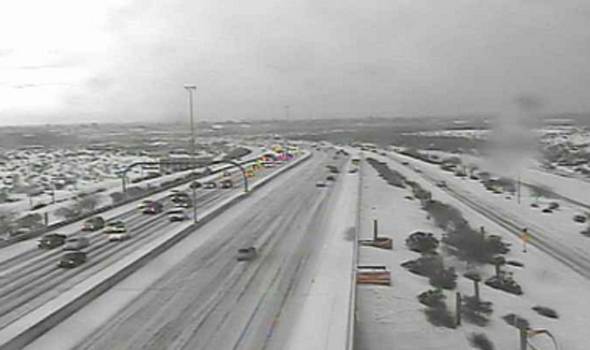
Something you don't see everyday, or even every year, in the Phoenix Metro area:

photo from KTAR, via Laughing Squid

Snow.  This is the 101 Freeway, near Indian Bend Road in Scottsdale.  It's actually not snow, it's "grauple", which sounds like something in a frat party's punch bowl mixed up from ingredients on hand, but is really a slushy mix of snow, hail and rain, but close enough to snow for these parts.

Scottsdale is in the northeastern part of Phoenix Metro.  Where we live, in north Glendale on the west side of town, we didn't get the grauple, only rain and a brief shower of pea-sized hail.  We were close to the site of the above photo this morning, driving thru rain to a doctor's appointment, but finished and got home before the weird stuff started falling.

The extra-weird part is the wild swing in weather within 24 hours.  Yesterday was shirt-sleeves and shorts weather, in the 70's.

One more picture.  Over at the edge of the southeast Phoenix Metro area, near where my mom and brothers live, are the Superstition Mountains of Lost Dutchman's Gold fame.  They're dramatic-looking things on ordinary days, but having snowfall gives them an additional snap.


photo by Steve Gotthart, via abc15.com

The Importance of Being Ernest


Over on Boing Boing, a recent post featured "Seven Writing Tips From Ernest Hemingway". One of the tips was:

"When you start to write you get all the kick and the reader gets none. So you might as well use a typewriter because it is that much easier and you enjoy it that much more. After you learn to write your whole object is to convey everything, every sensation, sight, feeling, place and emotion to the reader. To do this you have to work over what you write. If you write with a pencil you get three different sights at it to see if the reader is getting what you want him to. First when you read it over; then when it is typed you get another chance to improve it, and again in the proof. Writing it first in pencil gives you one-third more chance to improve it. That is .333 which is a damned good average for a hitter. It also keeps it fluid longer so you can better it easier."
 
Inspired by Hemingway's words, and having no shame, I decided to practice my revision skills on that advice itself:

[my edit] "When you start to write you get all the kick; the reader gets none. So use a typewriter at first; it's much easier and you enjoy it more. After you learn to write, your object is to convey every sensation, sight, feeling, place and emotion to the reader. To do this you have to work over what you write. Writing first with a pencil gives you an extra chance to improve, to see if the reader is getting what you want to convey. You get three chances: First when you read it over, a second chance when it is typed, and a third in the proof. One more chance to improve is a damned good advantage for a writer. It also stays fluid longer so you can better it more easily." [/my edit]
 
Fixed that for you, Ernie.

[Crosses "Rewrite Hemingway" off bucket list.]


Hemingway responds:
"The similarity ends at our beards."


2/18/2013

Scooby-Doo Cereal and Mini-Size Milk-Bones: Do Not Confuse


Mini-Size Milk-Bones &
Scooby-Doo breakfast cereal

Even if the dumb dog biscuits are called MILK-bones, they take FOREVER to soften up with milk.

Full disclosure:  When I was about ten years old, I really did eat a regular size Milk-Bone.  (One of my older brothers dared me to.)

Yes, sometimes I eat kids' breakfast cereal.  Because being a responsible adult and eating my daily oatmeal occasionally gets tiresome.


2/17/2013

WTF, Criterion?

This President's Day weekend, Hulu.com has made their Criterion Collection films available free, so I've been watching several movies I've wanted to see for a long time.

But what prompted this post was, while perusing the list of Critrion films available for viewing, I came across one called Equinox.  My reaction was to rear back in horror, going "Wha-a-a-a-a...?"

Way back in my mispent youth, when the local SF club CASFS was first being established, I was, for a while, the vice-president.  Like the National VP job, the position didn't have many official duties.  But one duty was to provide programming for the club meetings.  Sometimes this was discussion topics, sometimes audio (Bruce Dane provided tapes of the radio version of Hitchhikers' Guide To The Galaxy for one meeting), sometimes films.

At one meeting, where I had planned to show a particular film, the video rental store (remember those?) didn't have that particular film available.  So I perused the shelves and spotted something that looked like it might be of interest as a substitute.  That was Equinox.  From the description on the box, it not only had Harryhausen-type animation, but... hey!... Fritz Leiber was in the cast.


Fritz Leiber
Fritz Leiber was always one of my favorite sf/fantasy writers.  He also came from an acting background (his father, Fritz Leiber Sr., was a Shakespearean actor).  I'd met him once, and had dinner with him and a group of other people at the 1975 Westercon.  Leiber was a striking-looking man, with a high forehead and a shock of snow-white hair.  So I was interested to see how he came across as an actor.

It's said an actor can only be as good as the script he has to work with.  Lieber only had a few(mercifully) brief scenes in Equinox.  The movie's MacGuffin was an Evil Book Of Evil Evilness; Leiber played the professor who had discovered the EBOEE, and his main scene (dialogue-free) was basically to express dumbstruck horror at the Evil Evilness inside the book.

That scene didn't require much acting, because I'm pretty sure the book contained the script for the rest of the movie.  The years have mercifully blotted out most of the details, but Equinox was one of the most purely awful movies I have ever seen.  Clunking story, bad dialogue, worse acting, the stop-motion segments were unimpressive, and the direction and cinematography were awful.  Everything about the movie screamed cheap, amateur, and shoestring.  (It started out life as a student project.)

Showing that movie at that club meeting was one of the most embarassing moments I can remember.  As the malformed, spavined thing clunked on and on, people there kept looking at me with "What were you thinking?" looks on their faces.  And I couldn't bring myself to turn off the video player, because I kept thinking that somewhere, at some point in the movie, there would have to be some redeeming social value.

There wasn't.

So when I saw Equinox included as part of the Criterion Collection of films, my reaction was one of understandable horror and confusion.  The Criterion Collection includes a lot of "art house" films, and I've found a goodly number of those to be... well, boring.  But even with those I haven't personally liked, I've been able to recognize that there's some distinguishing value to be found.

But Equinox?  Bloody Equinox?  Stinking, clunking, wretched, abominable, painfully bad Equinox?

Criterion, really, what the fuck were you thinking?

(I've heard it said that map publishers will deliberately insert one very minor error into their maps, so that if the map is copied by others, the counterfeit maps can be identified by the presence of that error.  Could the presence of one undeniably bad film among all the other Criterion selections be something similar?)

A Broken Heart For That Post-Valentine's Breakup

2/15/2013

The Arm: First X-Rays


I finally got a copy of the x-rays from my original trip to the ER back in December.  This is what my shoulder looked like then.
 
Just to clear up any confusion, a shoulder is not supposed to look like that.  That has more in common with a train wreck than a normal shoulder.  Yeesh.
 
In other recovery news, started the "active" phase of physical therapy.  Discomfort and pain levels have gone back up, enough to start taking oxycodone again at night to sleep.  Improvement is slower than I'd like.  Also found out from my boss at work that if I don't recover enough strength and range of motion in that arm to be able to work without restrictions,I probably won't be able to return to the security work I was doing.  Whether I'd be able to move into some other position at the same company is questionable.  Life get complicated and uncertain.


2/09/2013

The Attentat of Christopher Dorner

For anyone who's been in a coma this past week:  Ex-LAPD officer Christopher Dorner went on a killing spree in California, targeting other police officers and the daughter and daughter's fiance of the police captain who was appointed as Dorner's defense counsel against charges of making false claims against another officer, charges which resulted in Dorner's firing from the LAPD in 2008.  Dorner recently lost a final appeal of those charges.

Dorner, before starting his spree, posted a "manifesto" online.  The overall intent of the document seems to be a suicide note, in view of Dorner's expectation that he will be killed rather than taken alive.  Latter portions of the manifesto are a rambling series of shout-outs to and comments on celebrities and politicians he admired or despised, a last chance to say things he wants to say.

The earlier portions of the manifesto lay out Dorner's grievances against the LAPD.  Dorner had accused another LAPD officer of kicking a mentally ill person, who was already on the ground, in the chest and face.  The eventual result was that Dorner was charged with making false claims against that other officer, and lost his job over it.

Dorner's claim is that his accusations were truthful, that the police code-of-silence resulted in multiple perjuries by other officers, the counter-charges placed against him were false, and that his defense counsel's true priority was protecting the reputation of the LAPD rather than defending Dorner.

Dorner's justification for his killing spree, and promises of more to come, is that all legal pathways to justice had been corrupted, the LAPD was systemically corrupt, and that extra-legal techniques -- essentially "going to war" against the LAPD, particularly the officers who had been complicit in his firing -- was the only recourse left to him.

LAPD's stance on the killing spree is that it's the act of a deranged madman.

But...

...it's difficult for a lot of people to not believe, and easy for a lot of people to believe, Dorner's claims of a coverup of the police brutality he'd reported.

In this specific incident, when the mentally ill person was released from jail, the person's father asked him what had happened to him.  What the person told his father was very close to the same events Dorner had reported, of an officer kicking him in the chest without cause.

So two different people reported, separately, the same events.

Add in the "code of silence" so common among police, where abuses and violations of policy go unreported, where beatings and shootings by police are always "justified", where protecting the jobs and reputations of police officers is always the top priority.

Add in that the Los Angeles PD in particular has a long past history of abuses and subsequent cover-ups.

It's easy to believe that Dorner was wronged.  It''s easy to believe the accusations he made against that other officer were true.  It's easy to believe that other officers closed ranks against him when he continued to press the issue.  It's easy to believe the "making false claims" charge filed against him was in itself false.  It's easy to believe he was railroaded.  It's easy to believe he was a good cop, betrayed by corrupt cops and pushed over the edge by that betrayal.

What Dorner is doing is an attentat, a "propaganda of the deed".  His particular case will end with his death, because the actions of the LAPD and other law agencies have made it clear that when they finally catch up to him, Dorner will die in a hail of bullets.  (The only question is how many innocent civilians will be shot and killed by police bullets before they do so.)

Dorner knows this.  His manifesto is, as noted above, essentially a suicide note.  But he wants the systemic corruption of the LAPD brought into public view.  And boy, has it!  The Internet is abuzz with people shocked by LAPD's shit-in-their-pants bullet-hosing of vehicles "similar" to the one Dorner was reported to be using, and expressing anywhere from sympathy for Dorner to outright approval of his actions.  The LA Times articles in particular seem to be garnering a lot of anti-police and pro-Dorner comments.


Wrong color, wrong size, wrong make, wrong model,
 occupied by two small Asian women rather than one big black guy.
"Close enough" for LAPD's finest to open fire.
In that regard, the "deed" has been successful in publicizing the "propaganda" to the public.  Does that justify Dorner's killings?  Certainly not when he targets not just the specific agents of his betrayal, but their families. 

But when is killing a cop justified?  Let's make a distinction here between "dirty cops" and "dingy cops".

When I consider the term "dirty cop", I think in terms of cops who take bribes, who steal, who get in bed with drug dealers, who do murder-for-hire on the side, cops whose actions are specifically criminal.  These are the undeniably corrupt cops.

Ideally, they'd be caught, tried, and sentenced to prison.  But if a dirty cop ends up in an alley with a bullet in his head... I'd be hard-pressed to shed a tear for him.

But what about the "dingy cops"?  These are the cops who look the other way when they see corruption and abuse by other officers, the cops who keep their mouths shut, the cops who will lie to protect fellow officers, the cops who honor the "code of silence".

That code is dysfunctional.  It enables and abets corruption and abuse.  It makes police into enemies of the public good, not its protectors.  Do "dingy cops" deserve to die?

Dorner has decided "Yes."  Dorner has broken that code, broken it with extreme prejudice and replaced it with his own code.  The message he is sending to the LAPD (and law-enforcement agencies in general) is simple: "If You Lie, You Die."

That's an extreme message.  But an attentat is always an extreme message.

That message shouldn't have to be sent.  The "code of silence" among police shouldn't exist; it's wrong, it's immoral, it's evil.  Nobody should have to die to challenge the existence of that code.

I hope there's a lot of soul-searching going on among individual officers, in the LAPD and elsewhere.  I hope they're thinking about what that code of silence has done to the institution and reputation of law-enforcement.  I hope they're thinking about how that code of silence has made so many citizens view them with suspicion, fear, and contempt.  I hope they're thinking about what following that code of silence has done to their own souls.

Because the only "good" ending to this whole affair won't be when Dorner is found and killed.  The only "good" ending will be if that code of silence becomes less endemic, less ingrained, less entrenched, and less acceptable.

2/07/2013

Milestone

Following up on the arm-related posts, today I was able to tie my own shoelaces for the first time in several months. Yay, progress!

Nothing like posting a photo online
 to make you realize how grimy your sneakers have gotten.
posted from Bloggeroid

2/06/2013

The Arm: Achy Breaky Arm

Finally got to see my orthopedic doctor at Mayo on Monday.  He reviewed the x-rays from the operating surgeon, plus a fresh set done at Mayo, asked me a number of questions about my recovery and progress to date, and checked how much strength and motion I currently have in that arm.

The bad news is: I probably will not recover a full range of motion in my right arm.  Most of this is because of the limitations of the prosthetic joint that was implanted.  He also noted that the remaining portion of the head of the humerus was very slightly off from its ideal position, and may make it more difficult for the rotator cuff on that side to work perfectly.

(This is not a slam against the operating surgeon.  The results are well within "acceptable" range, just not ideal.  There's always going to be factors like how quickly the surgical site heals, how much scar tissue forms, and how much stress the healing limb is subjected to during healing that can affect how quickly and how well the arm recovers.)

I'll probably recover most of the arm's range of motion.  But the extreme end of that range will probably be gone.  One of the things I did before the accident was a set of dumbbell exercises that, when I did them regularly, kept me pretty well-toned.  (Full disclosure: I usually didn't do them that regularly.)  Some of those, particularly the military presses, won't be possible any more.

If I was still delivering mail for the Postal Service, I'd be screwed.  Sorting mail in the mornings, and delivering the rest of the day, both involved lots of long and high reaches.  If I hadn't taken retirement in 2008, and had broken the arm while working for USPS,  I'd almost certainly have had to switch crafts and work as a clerk instead of a letter carrier.

My current security job mostly doesn't involve many of those sort of motions, so I don't anticipate too many problems when I've recovered enough range and strength in that arm to go back to work.  I'll probably find a few, and have to figure a workaround for them.

In the meantime, the right arm is still pretty much a putz in regards to its current strength and range.  I started the more active phase of physical therapy on Tuesday.  Ouch, but that's how I'll get as much use back as I can.

I've also been told I should start using the sling less during the day, and try to use it mostly when I'm sleeping.  The hand and forearm are back close to normal, so freeing them from the sling lets me use them for (lightweight) tasks. (Starting to do a little typing with the right hand again, though I try to keep some sort of support under my elbow when I do.  I was getting pretty good at left-handed typing.)  Push that a little too far, though, and I get some sharp pains in my upper arm and shoulder, so I'm being careful.

Prognosis: Aching with occasional painstorms, with clearer weather expected eventually.  Continued improvement, more slowly, more painful, less complete than I would have preferred.  So it goes.

2/01/2013

The Beard Is Back


One of the few benefits of breaking my arm and being off work for several months: I can let my beard grow back for the duration.

1/28/2013

Be The Book Mensch You Can Be

(This was originally written as a comment on John Scalzi's Whatever blog, to a post regarding his serial-in-progress novel, The Human Division.)

If readers are impatient and upset over having to wait for a book (or serialized sections, in this case) or pay a (small, so long as you don’t live in Sweden, apparently) premium for first look privileges, pray spare a moment for the feelings of books waiting to be read.

Are there actually people who don’t have a To-Be-Read pile of books standing by? Think about those poor books, waiting, and waiting, and waiting, to be put to their ordained purpose, only to have newer, fresher books placed on top of the pile, burying them like the unexcavated older layers of an ancient city.

If 99 cents is too much to bear for each section, wait for the consolidated e-book. Or buy the hardcover when it comes out; Scalzi’s a popular writer, so Amazon and B&N will probably offer hefty discounts when it first comes out. Or, since Scalzi’s popular, there’ll probably be a cheaper Science Fiction Book Club edition out a few months after the regular hardcover. Or you could even wait for the paperback. Or, if you’re really cheap, or just strapped for cash (I’ve been there), check with your local library to see if they’re planning to provide copies; if not, suggest they include it in their list of forthcoming purchases. (A lot of libraries now provide access to e-books as well; a lot of my lunchtime reading at work the last several years has been on my smartphone.)

In the meantime, let me propose a challenge: While waiting for the next Scalzi, or GRRM, or whoever, book, go to your TBR pile, dig out the oldest book in that pile, and make -that- the next book you read.

The book will be so grateful, and you will be an official Book Mensch, upholding the symbiotic relationship we should properly have with our books.

(Should I mention that my own oldest To-Be-Read book has been waiting since, ummm, 1972?)

The Arm: Latest Update


The latest report on progress with my broken arm is *sigh* no progress.

I had expected to report Friday that I'd finally gotten in to see my orthopedic doctor at Mayo Clinic's Phoenix branch.  This is the same doctor who did rotator cuff surgery on my other shoulder back in 2010, so I didn't expect any problems.

Got there Friday afternoon, to find there was a big problem:  There was no appointment.  It had been cancelled a week previously.  I called the number to contact the doctor's secretary, and got told the doctor had refused to approve the appointment.  When I asked why, I was told it was Mayo policy to not see patients who'd been previously operated on by non-Mayo surgeons.

Say what?

This was a bit upsetting, because I'd made clear when I set the appointment that I'd been taken to John C. Lincoln Hospital following the accident, and operated on there, because it was the closest place with a trauma unit, not because it was my provider of choice.  (Hilde and I have been getting most of our care at Mayo for years.)

Because the accident happened at work, it was being covered under Workman's Comp instead of my private insurance.  Because of that, I had to get permission to change doctors, from the surgeon who'd operated on me at JCLto my doctor at Mayo.  Since the Mayo appointment had been set weeks before last Friday with no caveats raised, I'd gone and gotten that approval pushed thru.  But that meant I was no longer a patient of the JCL surgeon.

So, for a few hours, it looked like I was suddenly in limbo, without any doctor at all to oversee my post-op care and treatment.  That was particularly important because one of the things I expected to come away with from that cancelled Friday appointment was permission to begin the more active phase of my physical therapy. 

(So far, I've only had passive exercises for the shoulder, where the therapist provides all the support and movement.  It's the active -- painful --therapy where the real strength and mobility comes back.  But the therapy place needed a doctor's permission and protocols before they could start that.)

Fortunately, things weren't quite that dire.  It turned out what I'd been told was wrong.  The actual problem had to do with that approval to change doctors.  Mayo had never received a copy of the paper from Workman's Comp's granting permission for the changeover.  After that was realized and I faxed Mayo a copy of the approval, a new appointment got set in fairly quick order.  Unfortunately, the first available date isn't until February 4th, which means more than another week's delay in moving to the next phase of physical therapy.

One important thing to note about this foofara is that the initial misinformation I was given by that secretary -- not my actual doctor's secretary, only the one who was available to answer that phone at the time I called -- only got corrected because I didn't stop at talking with that secretary.  After that disturbing phone conversation, I went to Mayo's PAL office -- Patient Administrative Liason -- and described my situation to the lady there.  It was only after she started making phone calls that it became clear the problem was a correctable one, and I wasn't really up Shit Creek without a doctor.

I'm still a bit perturbed, though, that the secretary I first talked to gave me information that was so seriously wrong.  Was she just misinformed, or talking out her hat, or off the cuff, or just Making Shit Up to get a bothersome patient off the line?  If I'd taken her words as a definitive answer, I'd... y'know, I'm not sure what my next step would have been; I certainly felt at a loss at the time.

So one lesson is: Keep asking questions, keep bugging people, keep pushing forward.

The other lesson is: Get a goddamn better answering machine for the home phone.  When the appointment was removed from Mayo's calendar a week prior, Mayo attempted to contact me.  After I got home Friday, I found the message on the answering machine.  This isn't the first time I've missed hearing messages for days.  The message indicator on the machine is so small and unobtrusive that unless you're right on top of it, it's easy to not notice it.  I had Mayo change my contact number to my cellphone; the little tiny icon that indicates voice mail messages on that is actually more noticeable than the landline's answering machine's tiny red light.  So I might have gotten things straightened out a week earlier if I'd gotten that message within a reasonable time.

This whole thing started with a stumble that turned into a fall that turned into a major injury.  I could do without any more stumbling blocks, thanks.

1/21/2013

The AR-15: What You Should Know, by David Belk

Over on Talking Points Memo, a gentleman named David Belk, who's worked in hospital trauma departments, shared in comments there what he's learned about bullet damage in general and specifically the AR-15's capacity for damage.  He's granted permission for reposting elsewhere.  I think it's a damn good little essay on the subject, so I present it here:

The AR-15: What You Should Know

How is the AR-15 different from most hunting and sports rifles as well as a hand gun? There has been a lot of confusion and misinformation about this, so let’s first start with some facts about guns, bullets and what they can really do to you.

First: The most important thing to consider in assessing the damage caused by any projectile (like a bullet) is velocity. One of the first things I learned when I rotated through trauma surgery at Los Angeles County Hospital is the difference in the wounds caused by high velocity (greater than the speed of sound) versus low velocity (e.g. most hand gun) bullets. Low velocity bullets only damage the tissue they directly penetrate. For a low velocity (hand gun) shot to kill a person, it usually has to pierce a major artery or the heart. Often, when a person comes into an ER with a gunshot wound from such a gun, the protocol would be to check for bleeding or other signs of organ damage and, if none were found, send them home in about two days without any surgical intervention. Most people who are alive when they arrive in ER with such a wound would go home in under two weeks even if they needed surgery.

A high velocity bullet (usually from a high power rifle, high power hand gun at close range or a shot gun) damages tissue in three ways: direct penetration, shock wave damage to distant tissue and a brief, several centimeter wide, cavitary lesion that opens around the path of the bullet. This causes wide spread damage to organs and other tissue several centimeters in all directions from the path of the bullet. If a person is hit with a high velocity bullet anywhere in the head, neck or torso, he usually dies. If he lives, he’s almost guaranteed months of recovery in the ICU, usually on a ventilator, and then years of rehabilitation after (if he’s lucky). I’ve seen what just about any type of gun can do to a person so I know this from experience.

The AR-15 has a muzzle velocity of 975 meters/second- almost three times the speed of sound. That means that each bullet fired from an AR-15 has an extremely high kill potential. How is this different from a standard hunting rifle (like a 30-06), a shot gun or a high powered hand gun (a glock or .357 magnum)? After all, a 30-06 can kill a grizzly bear so imagine what it can do to you.

One of the main differences between the AR-15 and other high power guns is recoil (kick). Because it fires a small caliber (.223) bullet, the AR-15 delivers a very small (4-5 ft.lb.) kick with each shot. A nine year old child could easily handle the kick of an AR-15. A 30-06 or a 12 gauge shot gun has four to five times as much kick per shot. It could knock over an adult who is inexperienced with shooting guns. This is why it’s very hard to find magazines of more than about four rounds for semi-automatic hunting rifles or shot guns. They are very impractical. The same is true for most high power hand guns. You need a very strong wrist and a lot of experience to wield one effectively.

Guns like the AR-15 also generate a lot less heat per bullet fired (again because of the small caliber). These two factors (weak kick and less heat per bullet) greatly increase the number of bullets that can be safely and easily fired in under a minute. All of these factors together make the AR-15 a gun that was brilliantly designed to do exactly what it was intended to do: Kill large numbers of people in a small amount of time. A teenager with very little training can easily fire 20-30 extremely lethal shots in under a minute with an AR-15 equipped with a high capacity magazine.

1/20/2013

Scraps & Fragments: When The Heck Did I Write This?

Over the years, I've written down notes and portions of unfinished stories on various notepads and scraps of paper.  And a lot of those notepads and scraps have gotten misplaced or buried over the years.

Looking for a pad to jot a grocery list down, I came across one of those old notepads, and the fragment of a story on one of the pages.  It's in my handwriting, and I have no memory at all of writing it.  From things written on some of the other pages, it's at least several years old, possibly a lot longer.

But I think the fragment is a pretty cool start to something, and I'll make sure it gets into the "Story Notes" file on my computer for possible further work.  In the meantime, I present it here:

     "October?"
     "Yes."
     "The entire month?"
     "Yes.  Missing.  Removed from the Chronostream."
     "Where the hell would he put it?"
     "I don't know.  But if it's not back in place before midnight on the last day of September, the past's momentum will crash it into the last second of that last day."
     "And?"
     "Everything will happen at once."
     "Sounds. . . hectic."
     "Worse than that.  The reason time exists is to spread out the energy of the Big Bang and allow matter to exist.  If time stops at the end of September, all the past's energy will be squeezed into that last second."
     "And?"
     "Essentially the universe will implode.  It would be like the Big Bang in reverse."


1/18/2013

In The Kingdom Of One-Armed Men, There Are No Fitted Sheets

I had my first physical therapy appointment yesterday.  I am feeling less optimistic about my rate of recovery from the broken arm than I was the day before.

I knew the arm's strength and range of motion have been strongly compromised since the accident.  Before going to bed, I've been doing some passive exercises each night.  I take the arm out of the sling and let it hang loose at my side, then rock my body back and forth to give the shoulder some mild range-of-motion exercise and keep it from freezing up entirely.  Not painless, but not sharply or intensely painful either.

At the PT place, my current range was measured.  I can only lift the right arm about 45 degrees to the front, and about 35 degrees to the side.  That was about what I expected.  But they also measured my grip strength for both arms.  The left (uninjured) arm was able to squeeze about 13 pounds on the gadget's dial.  Then I tried the right hand.

The needle barely moved.  Didn't even rise to the one pound mark.

That was unexpected.

In the accident, when I tried to break my fall with an outstretched arm, a shock wave basically travelled through my entire arm, from hand to wrist to forearm to elbow to upper arm until finally blowing apart the upper humerus.  The broken shoulder was agonizing (obligatory SF reference: "Your agonizer, please."), but the rest of the arm had been used in an overenthusiastic game of Crack The Whip and felt tender, bruised and painful to touch or try to use for weeks.

That slowly got better, and the lower arm, wrist and hand feel pretty much back to normal now.  So I've been using the hand and wrist for very light tasks, while trying to not move or stress the upper arm or shoulder.  But I was surprised to find out just how little strength I can exert with the lower arm and hand before accompanying muscle tension starts making the shoulder ache or stab.

But wait, there's more!

The head therapist told me there was a possibility that I won't recover the full range of motion I had before the accident, that I might only be able to get back to 85%, or even 75%.  (I've used this same PT place several previous times over the past decade, for back and knee problems; they're very good, so I trust what they tell me.)

That was not what I wanted to hear.   One of my main motivations for trying to stay fit and healthy thru the years is that, as Hilde's primary caregiver, I need to stay able to do what needs to be done for her, and to be able to do the things she's no longer able to do herself.  "Partially disabled" is not a label I want to wear.

It will probably also take longer than I'd hoped to get back to work.  Not so much because the job's so wonderful (doing graveyard-shift security is a lot of repetition and boredom), but because to get back to work, I'll have to be able to drive and I'll have to be able to write (to fill out daily logs and other reports) more than a few words or sentences without hurting.  (Locking and unlocking doors and other duties are things I can cope with left-handed, but driving one-handed is frowned upon and the security department's paperwork is all still done by hand.)

And both of those abilities are ones I want back for their own sake.  The writing goes without saying.  I could drive my own vehicle one-handed despite safety concerns, but the ignition switch is on the right side of the steering column, and when you can't even turn the friggin' key, the idea of driving oneself becomes pretty moot.  I'm getting a real appreciation for people who don't have cars or are unable to drive, and who have to depend on public transport or the convenience of others, because not having that ready and available transport on hand is a [ language! ][ such language! ][ oh, such language! ] hassle.

In the meantime, I'm still plodding along with life as a primarily one-armed man.  There are things I can't do.  And the things I can do usually take longer and use more energy.  (When changing bedlinens, working with flat sheets isn't that big a problem.  Putting a fresh fitted sheet on a mattress... that takes a while.)

1/17/2013

More Thoughts About Guns

image from the Uncyclopedia, by Handleyite

President Obama announced he'll be authorizing executive orders addressing the issue of gun violence.  A lot of sensible ideas, some a bit troubling.

Rather than buying into the "mental illness may lead to violence" line, which is fraught with potential for abuse, stigmatization and overreach, how about trying a "violence may lead to violence" policy.

Suppose "acceptable" violence -- non-lethal, non-weaponed violence like getting into school fights or bar fights, physical bullying (shoving, etc.), domestic-violence-lite like slapping (please note the airquotes I placed around "acceptable") -- was given gun-ownership penalties?  Get in a fight as a teenager, you can't buy a gun until you're 25.  Get in a fight, etc, as an adult who already owns a gun, you have to turn in that gun, even if it was locked in a gun safe at home, for a set period of years and can't buy another during that same period.  Second offense, much longer period.  Third offense, lifetime ban on gun ownership.  Violence involving any type of weapon (brass knuckles, baseball bat, knife) also invokes a lifetime ban.

Instead of "You have mental and emotional problems, so you might become a homicidal killer someday," how about "You have an actual past history of violence towards other people, so society is restricting your ability to purchase the tools to commit more extreme violence."

(Convicted felons are already banned from purchasing or possessing guns, though I think in many instances this ends when they finish probation.   Why does it have to be a felony?  Why can't a ban be lifetime for repeat offenders?)

Shorter version: "No Guns For Assholes."

Another thought, to address the "stockpilers" who buy dozens or hundreds of guns: A gun-purchase tax or fee with an escalating scale.  Your first gun purchase, a $100 tax.  You want a second gun, you have to pay a $500 fee.  Third gun, $2,500.  Fourth gun, $10,000.  And so on.  (This ties into my earlier post, positing that four guns is the maximum reasonable number for anyone to own.)

Mandatory liability insurance, suggested by numerous others, also sounds reasonable.

And, on the alternate-Earth where I serve as Semi-Benevolent World Dictator, a complete and utter ban on concealed weapons.  Nobody should have a "right to ambush".

1/15/2013

Cheap Thrills


I HAVE A BOX,
FILLED WITH CRINKLY PAPER.
LIFE IS GOOD.

 
posted from Bloggeroid

1/10/2013

Hands and Handguns

I thought I'd add a few of my own thoughts to the ongoing national debate over guns.  Also, I like to spit in the ocean occasionally, because that thing is just too damn salty.

That's The Shadow, famous old pulp-fiction crime fighter.  One of the baddest badasses to ever blast bad guys with bullets.  Now, how many guns does the Shadow use?

Two.  Why?  Because he only has two hands!

Bearing that example in mind, shouldn't the reasonable maximum number of guns any individual owns be... two?

I'll shoot down that conclusion myself.  Because handguns and pistols have their uses, but they're pretty much crap for hunting purposes.  (Yes, there are people who hunt using handguns.  There are also people who like to be tied up while having sex.)

For hunting, you need a rifle.  You need both hands to use a rifle.   So you only need one rifle.  That means the maximum reasonable number of firearms any individual needs is three, right?

Ehh, not quite.   There are some types of game (ducks and doves, for example) where you're trying to hit a small, fast-moving target at a considerable distance.  For that, you need either very good aim and a lot of time and a lot of rifle ammo, or you need... a shotgun.

So now the count stands at two handguns, one rifle, and one shotgun.

And I think that pretty much covers all the reasonable bases for owning firearms.  More than four seems excessive to me.

But, Bruce, what about collectors who buy guns for their aesthetic and artistic value?

Sure, as long as they only keep enough ammunition on hand for two handguns, one rifle, and one shotgun.  Have you considered collecting hood ornaments, or Snowflake Babies, instead?

But, Bruce, government tyranny, anarchy, Scary Brown People...!!!

There are medications to help you cope with those thoughts.  Anyone who feels a need to stockpile huge numbers of firearms, ammunition, etc., doesn't meet my definition of "reasonable".

So, in short, you only have two hands.  You can only use one rifle, or one shotgun, or in rare instances two handguns, at a time.  Is there really a good reason to own more than that?

Well, I suppose with modern technology and some engineering skills, you could rig something up to let you use other bodily appendages to fire weapons.  But the you run the risk of turning yourself into this guy:

CODPIECE
On the list of Lamest Super-Villains Ever, this guy is near the top.


1/06/2013

The Arm: Update and Progress

It's been nearly four weeks since my fall and breaking my right arm.  The arm still aches and throbs just about constantly, but to a lesser degree.  I make do with Tylenol and Aleve during the day, and take extra meds at night to try and sleep.  (The surgeon only prescribed about a week's worth of oxycontin when I was discharged from the hospital, but I had some old leftover T-2's -- Tylenol with a bit of codeine -- that have helped me get to sleep since those ran out.)

Sleeping has been a problem.  Reading some other people's experiences online, a common complaint seems to be trying to find a comfortable position to sleep in.  Short answer: There is no comfortable position to sleep in.  I've also found that when (finally) starting to drift into sleep, I suddenly have a feeling like I'm being buried alive that jerks me back awake, plus nightmares when I do finally get to sleep.  So I've added an Ativan to the night pills to reduce anxiety; it seems to help.  I still generally only get 3-4 hours of sleep that way, but I usually take some naps of 1-2 hours in the afternoons and evenings as well.

Still wearing the sling almost 24-7, removing it for a brief period at night to do passive exercises (letting the arm hang loose and moving the body around), then apply lotion before putting the sling back on for bed.    The wound dressing got taken off a few days ago, so I managed to take a shower for the first time since the accident; having clean hair again feels pretty damn good.

I'll have a fairly spectacular scar from the surgery.  A long incision line from the shoulder down into the upper arm, bordered by lines of dots where the surgical staples were used; it looks a lot like a crude centipede tattoo.

(I actually Googled "centipede tattoo" to see if anyone with a similar scar might have had a better tattoo placed over their scar.  I didn't really find many centipede tattoos I liked.  I did, however, find out that some actual breathing, living people have had tattoos of "The Human Centipede" permanently placed on their bodies.  If you don't know what "The Human Centipede" refers to, count your blessings; I'm not going to provide a link.  It's one of those things for which the phrase "That which has been seen cannot be unseen" is far too appropriate.)

Physical therapy should hopefully be scheduled and started in a few days.  Judging from my PT experience after rotator cuff surgery a few years ago, getting strength and range of motion back into my arm this time is going to be harder and more painful.  The right arm's lost a lot of strength and range of motion, more than following the rotator cuff surgery.  I think it will probably be at least the beginning of February before I get released back to work.  My job isn't particulary strenuous, but there are some tasks that require the use of both hands, I'm sure they wouldn't want me driving the golf cart one-handed, and writing (for reports and logs, etc) is still pretty damn painful after even just a few words.  (Typing left-handed is awkward and tiring, but do-able.)

Ukelele Therapy, And More

While I'm recovering from my broken arm and waiting for physical therapy to be scheduled, I've been browsing the internet for other people's experiences with their own broken arms.

An especially interesting way to cope come from this comment on a forum for guitar players:
When I did my left shoulder in (broken fingers and thumbs and wrist/forearm too in past, and legs/ankles), I regained full use in about half the normal time, by learning to play the ukulele - it requires very little effort and no arm movement but the finger wiggling is apparently the best physio exercise you can do. Probably manage a ukulele whilst in plaster, did they they tell you to wiggle your fingers?
 
Yes, the ukulele.  The fellow quoted had a left arm injury, rather than right-sided like mine.  But I think it might still be do-able if, after consulting with a PT professional, I decide to try it.

(One of the more constant things on my unwritten Things To Do Before I Die list has been "Learn to play a musical instrument."  That list also includes "Learn to read & write music" and dozens of other tasks and aspirations.)

I've found there are lots of pre-made ukuleles available, ranging from very basic models around $70 up to more deluxe and/or electrified versions costing hundreds.  For those willing to invest a little sweat-&-glue equity, there are DIY kits available, or instructions for making your own from a variety of materials, such as the legendary cigar-box uke, and even a ukulele made from cardboard.

There are a number of websites devoted to ukuleles, like the Tumblr blog Fuck Yeah Ukuleles (some images may be NSFW; a small substratum of ukulele players apparently prefer to play naked).

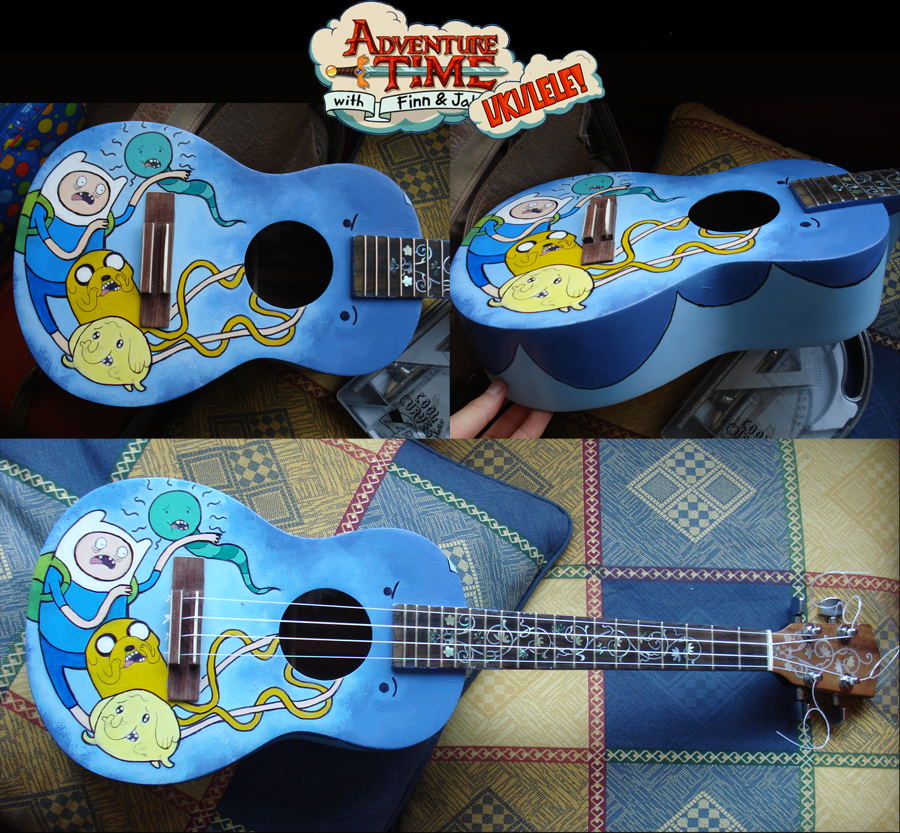
Besides being used as a musical instrument, some people use the surface of the ukulele as an art surface, handpainting the bodies in a multitude of styles and themes.  Here's one for a fan of the ADVENTURE TIME cartoon:

painted by Jenny7332 on deviantart.net

Some custom ukuleles have variant shapes.  There's actually an Autobot theme ukulele:

made by Celentano Woodworks

I gotta admit, tho', I'm not a big fan of Transformers, so that Autobot ukelele doesn't really excite me.  But with a bit more Googling, I found a ukulele that actually transforms.  Behold, the Folding Ukulele!:


The folding ukulele was designed by a guy named Brian Chan, who unsurprisingly is also an expert origamist.  It comes as a DIY kit made from laser-cut bamboo and additional hardware.  Reviews give it lower marks for sound quality, but the coolness factor is sky-high.

The weirdest ukulele, though, is probably a South American variant called a charango.  The charango's body is traditionally made from the shell of an armadillo:


Does all this mean you'll see me with a ukulele of some sort in the future?  Mmmmmm. . . maybe.  I would be a lot more likely to take it up in private, rather than public.  I'm not an extrovert, unlike some people:


That's John Scalzi, author of Old Man's War and other books, head honcho of the popular Whatever blog, and public ukuleleist.  I like John's writing, but I gotta admit I think I admire him most for his ongoing efforts to make being a goofball more socially acceptable.  Still-closeted goofballs everywhere thank you, John.



1/05/2013

Notes From The WTFiverse: An American Doctor Who

I was musing a while back about an alternate universe where DOCTOR WHO has been an American TV series, rather than British.  I came up with a number of American actors who I think would have been suitable to portray various Doctors through the years.

(I'm most familiar with the modern Doctors, Nine thru Eleven.  Saw some of the Fourth Doctor episodes back when they were showing on PBS in America, although I don't think I ever managed to catch a complete story arc.  And snippets of most of the other Doctors over the years.  So the following suggestions are more in the general line of attitude, charisma and the actor in question showing a previous capability for playing odd or eccentric characters, rather than matching a particular actor with a particular Doctor.)

For some of the earlier Doctors:


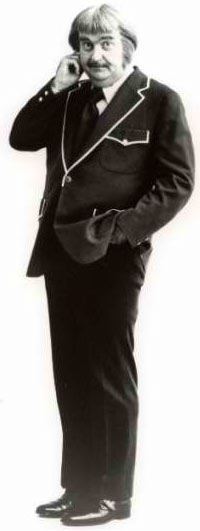
BOB KEESHAN -- aka Captain Kangaroo.  He wouldn't even have to change his wardrobe.  (He was also the original Clarabelle the Clown on THE HOWDY-DOODY SHOW. )


DICK VAN DYKE -- When he played Rob Petrie on THE DICK VAN DYKE SHOW, he sometimes gave the impression that he had come late to living on Planet Earth and that the people around him were frequently a puzzle.  And he sometimes moved his body as if it weren't quite jointed like humans were jointed.  And, on one episode of TDVDS, he actually dealt with an alien invasion!


JOHN ASTIN -- If had to choose only one person to play an American Doctor, this is the guy.  As Gomez Addams on THE ADDAMS FAMILY, he overrode the normal world through sheer force of personality and charm.  And didn't it seem like the Addams family mansion was bigger on the inside?  And as an extra added bonus, maybe Morticia (Carolyn Jones) as the Doctor's Companion?  (I actually first noticed Astin on an earlier sitcom, I'M DICKENS, HE'S FENSTER.  A notable later project was the tv-movie/unsold-pilot EVIL ROY SLADE.)


Now some suggestions for the more modern era:


JON DELANCIE -- Best known for "Q" on the various STAR TREK incarnations.  Played an alien with highly advanced powers and resources.  Frequently squabbled with his own civilization.  Enjoyed dicking around with people's heads, but also seemed to have a need for occasional human company.  Seems like a shoe-in.

MICHAEL J. FOX -- Already an experienced time traveller.


PEE-WEE HERMAN -- Do I really need to say anything more? (Note:  In DW comics continuity -- 2009's Silver Scream -- the Doctor used "Pee Wee Herman" as an alias while visitng 1920's Hollywood.)

Feel free to add your own suggestions in comments.

1/03/2013

In Which I Wrestle With Tigers

I recently ordered several small items from online companyTigerDirect. This is the email I sent while waiting (and waiting) for TigerDirect's customer service department to answer my phone call:

At this moment, 11:20 AM, 1/3/13, I am going into my third hour of waiting for your customer service phone # to connect me to a representative.  If this is your idea of "service", it's a good way to keep first-time customers from ever being second-time customers.  Over two hours waiting so far, with no end in sight?  Would you tolerate that from any company YOU were trying to contact?

The problem I'm trying to contact you about is almost as absurd.  I made a recent order for two small items.  For some reason you decided to send these items separately.

I received a package today.  The package had not one but TWO shipping labels attached.  One label, UPS tracking # 1Z 9E1 248 03 5684 3664, was addressed to me.  The second label was not only addressed to someone completely different on the other side of the state, but the return address for that second label was NOT for TigerDirect; the return address was for an Office Depot about ten miles from where I live.

Both labels appeared to have been applied carefully and smoothed flat.

Can you explain how two different companies, thousands of miles apart, can put two different shipping labels on the same package?  Because I sure can't think how that could happen.

When I checked the package's contents, it turned out to be for the customer shown on the second label, the one from Office Depot to Sacaton, AZ.  No items from my order with you were included.

Since the package was delivered to me regardless, I assume UPS scanned the tracking # on the label addressed to me.  This would mean that whatever merchandise was SUPPOSED to be sent to me with that label is now classified as "Delivered."

So let me make it clear: NONE of my order has been delivered.  At this point, I'm not feeling too optimistic that ANY of my order will EVER be delivered.

And I'm especially not optimistic that your customer service reps for customers trying to phone in are EVER actually going to answer my phone call.  It's now close to THREE HOURS since I first called, and I'm still getting the recorded message asking me to wait. At this point, it's a question whether or not my call gets an answer or the phone's battery dies.

Could you do me a favor?  Can you show me that TigerDirect actually has even a tiny smidgen of care about its customers?  Then stand up from where you're reading this email, go over to wherever the phone reps are supposed to be working and WAKE THEM THE HELL UP, or tell them to call a stop to the hot craps game, or to stop photocopying their butts on the Xerox machine.  Because whatever it is they've been doing for at least the past three hours, it's NOT providing service to customers.

If I sound furious and disgusted, it's because I am.  How have you managed to stay in business so many years?

sincerely,
Bruce Arthurs
 

Yes, I get grumpy sometimes.