This has been noted many times, in many media, over the last several months. But I wanted to do a signal boost for two particularly noteworthy, and ongoing, radio drama series about World War I, the BBC Radio4's Tommies and Home Front.
 Tommies is a weekly dramatization, based on private diaries and other records, of the experiences of British officer Mickey Bliss and his fellow signallers, from the Lahore Division of the British Indian Army, on the battlefields of France. It gets pretty intense, both from a military-history viewpoint and in the clashes and interactions between the varied characters and personalities who took part. It's messy and chaotic and Things Going Wrong. There's even kind of an SF element to it, with Bliss and his men responsible for one of the first field radio units, an affair with equipment weighing hundreds of pounds, difficult to set up and maintain, and delicate and cranky enough to frequently fail to work without frantic MacGyvering with spit and tin foil.
 Home Front is the same war, only, well, back on the Home Front in the British Isles itself. There's the same messiness and sense of depth, deeper than usually presented in historical dramas in the period. The large cast of characters even includes a German national stranded in Britain at the war's outbreak. The plan for the series is to eventually provide a day-to-day drama covering the entire course of the war.
Both dramas provide a closer, more intimate eye on the issues and lives of participants in World War I, rather than the sweeping, epic, pieces-on-a-gameboard overview more commonly presented.
Episodes of Tommies can be listened to here, available until December 11th. Home Front, which is presented in shorter 15-minute episodes five times a week, can be found here; there are also "Omnibus" editions of Home Front, collecting an entire week's episodes in one bundle for download and podcasts, available here. The Home Front episodes are available for listening "indefinitely", both directly online and via download; the Tommies episodes are only available until December 11th (no podcasts or downloads, alas).
- - - - -
The other anniversary of note happened fifty years ago, rather than a century. That was the founding of the Free Speech Movement at the University of California at Berkeley (UCB for short) in 1964.

The FSM gets little note in most histories nowadays. It seems to be remembered more as a "wanting to be able to use dirty words" thing than anything else. It was quite a bit more than that, and it was the originating point for later, larger, more widespread protests against the Vietnam War.
UCB had been the site for numerous advocacy committees and organizations setting up tables and passing out literature for various causes (anti-death penalty, pro-civil rights, and early anti-Vietnam activity, etc.). In November 1964, the UCB administration attempted to enforce a complete ban on such activity.
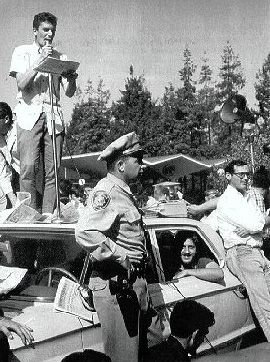 |
| Mario Savio speaking from the top of the police car, Oct 1, 1964. Credit: Steve Marcus, courtesy of UC Berekeley, The Bancroft Library |
Berkeley has produced a website about the FSM era that provides a lot of the history and background for those events and the persons involved in them. A useful timeline can be found here.
