Showing posts with label The Arm. Show all posts

12/23/2014

The Arm: Two Years On

December 10, 2012 was the morning I took a hard fall onto a harder sidewalk at work, badly breaking the upper arm bone and messing up a lot of the shoulder, and ending up with an artificial joint and lasting after-effects. I've written about the accident and the recovery (such as it's been) over a series of posts.

So how I'm doing, two years later?

I had an exam and evaluation by an independent (i.e., picked by Workman's Comp) orthopedic surgeon several months ago, and got the results about a month ago. I've been put into a "stable without full recovery" status, which lets WC put my case into an Inactive category, and the doctor rated my right arm as 40% disabled.

That sounds about right. The range of motion, the strength, and the stamina of that arm are all compromised significantly, and look to be for the rest of my life. The good news is that the pain, so long as I remember to take my aspirin/tylenol tablets regularly, is (most of the time) down to a mild ache.

Besides the actual physical limitations of that arm, I find myself continually annoyed by a sense of trepidation in using it. If I want to do something that requires use at the outside of the arm's new parameters, I find myself hesitating and asking myself: Will I be able to do this? Will I need to ask for help? Will it hurt? How much will it hurt? How long will it hurt afterwards?

Annoyance and frustration on an every-damned-day basis. The possibility's been raised of doing a revision of the joint replacement, replacing the standard-model arthroscopy with a "reverse-shoulder arthroscopy". But there's no guarantee of improvement, and a possibility the new joint would be less useful and more painful.  I can continue to live with the current status quo, even if I'm not pleased about it.

I'm fortunate in that I'm still able to perform my current job's work tasks within those new limitations. If I was still working my old job as a letter carrier, involving reaching and stretching and lifting that arm thousands of times per day, I would be completely screwed; for that job, the disability would be 100%.

So that's where I'm at, and where I'll probably be for the foreseeable future.

(Hmmph, this sure is a grumpy post to make a few days before Christmas.)

1/01/2014

My Year In 2013

And why not add my own gobbet of spit to the year's-end tsunami of "Best of" lists and retrospectives for 2013?

2013, the Good, the Bad, and the Ugly:

Start with the Bad:  The biggie for the year was recovering, such as it was, from the bad arm break and shoulder injury from December 2012.  I wrote a series of posts throughout the year (see all the "The Arm" posts here) detailing the various ups and downs on that front.  At year's end, I still have trouble and pain from that shoulder; if I don't remember to take a couple of hefty aspirin/Tylenol tablets several times a day, I notice.  Oh, how I notice.  (A small pillbox is now an obligatory part of my pants-pocket inventory, along with wallet and car keys.) 

Range of motion and strength for the arm are still significantly compromised.   I figure I can still do about 80% of what I used to without more than mild discomfort, then about another 10% involving stronger reaching and grabbing and lifting that I can do but have to work thru discomfort/pain to do so.  And then the last 10% beyond that, which the arm just plain Don't Do Dat Shit No More.

It is what it is.  I deal with it.  But sometimes I deal with it by feeling broken and fragile and old.

Which leads into the Ugly:  In 2013 I got yet another year older.   This happens every damn year.  What is up with that shit?  In a sensible universe, you'd be able to skip that whole aging schtick once in a while.  Somewhere, there's got to be a button you can click for a drop-down menu that includes "Stop Aging" or even "Get Younger" options.  I'm getting a little tired of looking in the mirror to see some grumpy-looking old guy with a receding hairline and advancing wrinklage looking back.

But, hey, let's end this post with something a little more upbeat, the Good:  2013 was the year when I started writing and marketing fiction again on a moderately regular basis, after falling out of the practice back around 2006.  Ironically, it was in large part because of the broken arm and subsequently being off work for months that I started up again.  I've found myself enjoying the process again, enough that I've tried to continue writing even since going back to work at the end of July.

Concurrent with starting to write fiction again, I seemed to enjoy reading more this last year.  I've delved into the explosion of self/indie-published books that have come out the past few years.  That experience has been mixed.  I've found a few gems, some pretty decent books, but also a large proportion of books that should have been worked over and rewritten more before publishing, and *sigh* a few that just made me cringe.

(The self-published work I enjoyed most this past year was THE DIRTY PARTS OF THE BIBLE by Sam Torode, a picaresque bildungsroman set in 1930's Hobo America with a slight supernatural element.  My own review here.)

Among works from traditional publishers, I found myself reading ebook versions, or listening to audiobooks, more than printed hardcovers or paperbacks.  Primarily this is because I have my smartphone within easy reach on my belt almost every waking moment; with several reading apps installed on the phone, I have access to a choice of books -- there are about 50-60 books downloaded to the phone at the moment, plus I can borrow library ebooks and audiobooks via the Overdrive app --  without having to carry around an additional bulkier object to read during free moments.  Convenience trumps physicality.

My favorite traditionally-published books this year was an older one from 2001, Pat Murphy's ADVENTURES IN TIME AND SPACE WITH MAX MERRIWELL.  It was fun to read.  This 2010 review by Tansy Rayner Roberts says pretty much everything I'd say in a review of my own.

And so ends 2013.


(I've mentioned it before, but Tatsuya Ishida's SINFEST
is one of my favorite webcomics, including the traditional year's-end sequence
\when Death goes on the hunt for Father Time.
Big archive, large cast of characters, long backstories,
and multiple plotlines, but worth the effort to get into.)

7/30/2013

The Arm: Back To Work, Finally

At the end of our last thrilling installment, the arm pain had improved remarkably for no discernible reason, enough so that the second shoulder surgery set for the end of June was cancelled, and I was referred to a physiatrist (musculature specialist) at Mayo for further evaluation and probable return to physical therapy for a while.

Between various scheduling, authorization and paperwork complications, I didn't see the physiatrist until July 19th.  The arm pain had continued at the reduced level, staying mostly in the lower half of that 1-to-10 pain scale doctors like to use, and with the use of aspirin and Tylenol several times a day, mostly in the lower half of that lower half.  And those lower levels keep me out of the Stupid Zone, where you can't ignore the pain and you can't think.

At those lower levels, I felt it was possible to finally return to work.  The upper arm and shoulder still feel stiff and sore a good amount of the time, but it's probably never going to be completely pain-free again for the rest of my life.  The doctor had a job-description sheet from my workplace, and we went over the list of tasks I need to perform at work, none of which I felt were un-doable.  (Some of them, involving high reaches or other extensive arm movements, need to be done with the left arm rather than the right, but they can be done.)  So he gave me a release to return to work as of July 22nd, within the right arm's limitations.  He also wrote orders for me to resume physical therapy for the next month, and scheduled an appointment for re-evaluating my progress in late August.

Then I had to contact the HR rep at work to see about actually resuming work.  Monday the 22nd I met with her and the assistant Security head, then went around the property with him to demonstrate that I was physically able to do the work required.  I didn't have much problem with any of the tests, so I got a call Tuesday morning to say I was back on the work schedule starting Thursday night.

Completed my first work-week back at work Sunday night.  No major problems.  The shoulder got stiff and sore a few times, but that was expected and I carried a small pillbox with extra aspirin/Tylenol tablets for those occasions.  So it looks like I'm a working stiff (heh) again.

The Arm saga isn't over quite yet.  My job isn't strenuous; it doesn't require lifting or moving any heavy objects, at least not any I can't handle left-handed.  But there's still a lot of stuff at home I'm not capable of without over-stressing the arm.  That's one of the reasons for going back to physical therapy, to try and get back some of the strength and stamina the right arm has lost over the months.  (The right arm is visibly thinner than the left, due to muscle loss from lack of use.)

So there'll probably still be occasional post about "The Arm" from time to time.   But, at least as of now, they should be farther apart in time and hopefully less dramatic than some of the posts have been.

6/21/2013

The Arm: The Weasel Gets Weird -- Unexpected Changes


In my last update to the seemingly neverending saga of coping with the breaking the hell out of my right arm last December, I reported that I'd decided to go ahead and have the revision surgery, replacing the standard replacement humerus head implanted in December (and which had seemed to be failing, resulting in quite a lot of pain) with a Reverse Shoulder Arthroscopy, a different type of replacement shoulder joint, hopefully (but not guaranteed) to reduce the amount and intensity of pain I was having.  That surgery was scheduled for June 28th.

And then, beginning last weekend, an unexpected thing started happening.

The arm started hurting less.

Quite a lot less.  I've gone from six extra-strength Tylenol and two Aleve (or, occasionally, one Aleve and a Celebrex) per day (about the maximum dose you're supposed to take per day, or start worrying about liver and kidney damage), all the way down to one or two Tylenol and one Aleve.

I don't know why it's hurting less.  No apparent rhyme, no apparent reason.  I don't know if it's going to last, or if the pain will rack back up at some unknown future date.  But you'd think I'd be relieved and grateful for the change.

In actuality, I experienced an anxiety attack that came close to panic.

For the first several months after the acccident, I seemed to be making slow but steady progress in recovery.   So I thought I'd probably be able to go back to work sometime in late spring.  Then the arm started getting worse again in late March, and planning on the future went into a cocked hat.

When I finally decided, about two weeks ago, to go ahead with the second surgery, it meant that I'd know what my life would be like for at least rest of the summer and most of fall:  Surgery at the end of June, the arm in a sling and immobilized 24/7 for at least six weeks, followed by at least several months of physical therapy.  After that, things would be uncertain again until it became clear if the second surgery had made any improvement.  But at least I knew what would be happening for the next four months.

But when the arm suddenly started hurting less, I had to start wondering if the second surgery was absolutely necessary.   The arm still aches, but the aching is a lot less intense, and I've had very few of the sharp stabbing pains I was having before.  Two weeks ago I was at the point where I was sure I needed the new surgery.   And now... I'm not sure.

Which makes the future very uncertain again.  Which is very upsetting and anxiety-inducing.

So.  After nearly a week of the lower pain levels, a few decisions have been made.  The revision surgery has been cancelled.  I'll be referred to a physiatrist, a specialist in Physical Medicine and Rehabilitation.  We'll try and work with the arm to get its strength and stamina back, or at least better.

I'm still, whatever happens, going to end up with pretty significant limits on how high I can reach with the arm, and how much I can carry.  But the pain has been the most compelling problem these last months.

I also had an out-of-pocket consultation with the doctor who does Hilde's pain-management for her own significant problems.  I got a fairly long list of non-surgical, non-narcotic treatments and medications that might be useful in dealing with the remaining pain.  (One of the suggestion was for adhesive Lidocaine patches.  Hilde used those for pre-surgical pain before one of her joint replacements some years ago, and we still had a partial box way at the back of a closet shelf.  So I tried one today for the aching, and it helped significantly.  This makes me hopeful that I can continue to keep the pain at tolerable levels.)

(Hilde and I get most of our medical care from Mayo, who I mostly think of as wonderful.  But surprisingly the only pain-management service Mayo has is part of the Neurology department, and it only treats back pain.)

There are still a lot of  "If's" and "Maybe's" and "Possibly's" floating around in the forthcoming months.  But for the moment, things are better than they have been.

In the last update, I said the pain was like having a bad-tempered weasel strapped to my arm.  It growled a lot, and sometimes started clawing and biting at the arm.  Well, at least for the time being, it's being a lot nicer, growling less, and even sleeping some of the time.

A well-behaved weasel.

6/09/2013

The Arm: Latest Update, or, Wearing the Weasel

At last report, in early May, I was waiting to see a different orthopedic surgeon for a second opinion before committing to the Reverse Shoulder Arthroscopy surgery  recommended by my doctor at Mayo.  The second surgery will "probably" reduce my current pain levels, but even if fully successful I'll still have reduced strength and range of motion in my right arm for the rest of my life.

I saw the second doctor on May 8th, then waited for him to send his recommendations to the Workmens Comp office and to my Mayo doctor.  Then waited until the Mayo doctor got back from an out-of-town trip to have a phone consult with him.  Then waited until my Workmens Comp caseworker got back from her out-of-town trip.  Then found out she needed a second recommendation for the surgery from my Mayo doctor, to reflect that he'd received and considered the second doctor's findings.  So had another consult with the Mayo doctor a couple of days ago, rather more in-depth than we'd done over the phone.

The second doctor also recommended surgery, but the RSA surgery was one of several possible paths he suggested.  Another was to re-do the standard joint replacement surgery I'd had in December, with hopefully better results. And of course the option of learning to live with chronic pain was also brought up.

That last one's not really an option, however.  At this point, pain relief is my top priority.  Rebuilding strength and stamina in the arm come second.  Range of motion actually comes in third.  It doesn't really matter how much range the arm has, when it hurts too much to actually do  much of anything with it.

The degradation in usability and increase in pain that started in late March seems to have not only continued, but even worsened somewhat in the last few weeks.  I still usually manage to get through the days by taking lots of Tylenol and Aleve, but there've been a couple of recent days where the pain was sharp enough and persistent enough that I took half a T-4 (Tylenol with codeine) to get some relief.

Besides taking a lot of analgesics, I try to avoid activities that might cause the persistent ache to turn into sharp stabbing pain.  When I move the arm, I try to move it slowly and carefully.  I try to not lift or carry anything weighing more than a few pounds, or for a long period.  In short, the most effective pain-avoidance strategy has been: Don't do jack with that arm.

An extra hassle to all this has been not just the pain, but the fear of pain, the apprehension that trying to do anything with the arm will set it off.  I'm in a near-constant state of hyper-alertness, constantly asking myself: "How far will I need to reach out with that arm?  Can I do it using my other arm?  Will I have to lift, or squeeze, or twist anything?  Will that hurt?  How badly will it hurt?  How long will it take to recover?  Is this worth doing at all?"  This, above and beyond the physical pain, gets tiring.

I do do stuff with the arm, but nothing heavy, and nothing for an extended period of time.  Even very light work like sorting papers will increase the pain after a while.  When the aching gets intense, I've found I can reduce the recovery time by putting the arm back into its post-surgical sling and letting it rest for several hours.  And one of the few things I've found that I can do for a reasonable length of tie is sit at the computer and keyboard; by resting my right arm on the arm of the chair and bringing the keyboard and/or mouse closer, I can even type or browse the Internet for a reasonable stretch.  (One of the main reasons why you're seeing more postings here than prior to the accident.)


Yeah, something like this.
It's sort of like having a bad-tempered weasel strapped to your arm.  Most of the time the little bastard just lays there and growls; but sometimes he'll have a sudden psychotic break and start clawing and biting.
"Don't do jack" is not a viable long-term strategy, however.  Recovery isn't just a matter of being able to return to work; it's being able to do the things that need to be done in my personal life.  That includes being a caregiver to Hilde, and being able to do the household chores and tasks that need doing.  If I wasn't having the chronic pain, I'd be able to cope with a lot more of that even with a partially-disabled arm.

When I talked to my doctor at Mayo on Friday, he went on at some length to impress on me that there are no guarantees that I'll come away from the RSA surgery with any significant improvement.  I will definitely still have an impaired range of motion, and I won't have as much strength and stamina in that arm as before the injury.  There will "probably" be less pain, but there may still be some pain in the arm afterwards, and there's the possibility of no improvement in that area either.

From the medical articles I've read, shoulder surgery in general is a tricky job.  It's even trickier for a traumatic shoulder injury like mine, and trickier still for a revision procedure to a previous surgery like the RSA would be. I came across a discussion forum for shoulder-surgery patients, and one of the participants whose problems also started with a traumatic injury -- thrown from a horse and trampled -- has had six surgeries and still has chronic pain and little use of her arm.

I don't want more surgery.  I don't want more months of an immobilized arm followed by months of physical therapy.  But if the alternative is to try and live with the current status...

Well, even the hope of improvement is something.

In short, I'm scheduled for the RSA surgery on June 28th.

If the results of the surgery are good, I'll probably be able to return to work sometime in the fall.  If the results are less than good, I may have to start thinking in terms of Long Term Disability (and all the paperwork and complications that would entail).

4/27/2013

The Arm: A Brief Update

As expected, the insurance company providing Workmen's Comp coverage for my employer wanted a second opinion before agreeing to new surgery and a revision of the original shoulder arthroplasty from December.  So I'm scheduled for an "independent medical examination" on May 8th.  The doctor they're sending me to seems well qualified; he does a lot of knee and shoulder repairs for professional and collegiate sports teams here.

Still having problems, sometimes significant problems, with pain and stiffness in the right arm.  I move the arm slowly and carefully, because quick or abrupt movements make the chronic deep ache turn into sharp bolts of pain.

I don't like taking narcotics, and so far I've managed to get by with doses of Tylenol and Alleve and an occasional Celebrex.  But I'm taking more OTC analgesics, more often, than I ever have before, and that comes with its own cautions.  (Watch those kidneys!)

At this point, as inconvenient and unpleasant as additonal surgery might be, it looks like the best course of action.  Because living like this isn't a long-term option.  This is a drag.

Yeah, "like something the cat dragged in."  Exactly.

4/06/2013

The Arm: Pain Issues, and A Probable Re-Do

My most recent post about breaking my arm and the subsequent recovery process, "Two Steps Back", reported that I'd started experiencing a recurrence of pain at a level similar to a month or so after the surgery in December.

Up to that point, about mid-March, recovery had been slow but forward.  My range of motion and ability to use the right arm fell into three categories:
  • The Functional Zone, essentially pain-free, mostly involving use of the hand, wrist and forearm, plus about 40 to 45 degrees of forward-lifting motion (less for sideways motion) for the arm as a whole. 
  • Then there was the Uncomfortable Zone, up to about 90 degrees forward, where I could feel some strain and aching while I was using the arm, but the strain and ache would recede quickly when I dropped back into the Functional Zone. 
  • Then there was the Forbidden Zone, trying to go up past that 90-degree point (only a few degrees unassisted, a bit further with assistance or exercise pulleys), where the aching slid into the point of actual sharp pain, and where it would still ache and throb for a fair while after dropping back into the more usable Zones. 
  • Also, the overall strength of the arm was much better than when I first started therapy for the arm, but still a lot weaker than before the accident.
A lot of that progress has been lost.  When the pain started getting worse again, it was accompanied by intermittent scraping and grating sensations from within the shoulder.  (Not all the time, but any scraping sensations is cause for worry.)  Currently, even when the arm is just hanging at my side, there's a slight but noticeable aching; using the arm beyond that, even the light use I hadn't had much trouble with, makes the aching stronger, eventually going into actual sharp pain.  I've gone back to wearing my arm sling again when it gets bad; having the arm supported gives some relief, but it still takes longer, sometimes a lot longer, for the pain and aching to recede. 

The Functional Zone has shrunk, the Uncomfortable Zone has increased, the Forbidden Zone is still forbidden, and pain has become more chronic again.  This is not good.

I had a fresh set of x-rays done after the grating sensations started, and I was able to move up my next appointment with my orthopedic doctor at Mayo.  I saw him yesterday.

I was hoping what he'd tell me was "Your problem's simple.  I can do a laproscopic procedure, minimally invasive, in and out the same day, and you'll be back on track to recovery quickly."

No such luck.  The major source of problems appears to be that the tuberosity where the rotator cuff attaches to the humerus head replacement is displaced by a significant margin.  This is equivalent to having a major rotator cuff tear.  (And probably explains why I was able to get my arm up to 90 degrees with therapy, but increases beyond that have been minimal and painful.)

My doctor at Mayo isn't the surgeon who replaced the joint in December.  Immediately after the accident, I was taken to the closest hospital with a trauma unit, and the surgery was done there, not at Mayo, where I receive most of my usual medical care.  While it's a nearly unbreakable rule for doctors to badmouth other doctors, I felt a clear vibe of "If it had been me doing the replacement, you wouldn't have this problem."

A couple of additional factors may also be contributing:  Besides the actual break in the arm bone, the shoulder bones were badly compressed and squeezed in the accident.  There may still be lingering trauma after-effects from that.  And there was also a small shadow in the new x-ray that the doctor thought might be a loose bone fragment floating free.

The doctor offered several possible ways to proceed from this point:
  • Continue as before, with exercise and physical therapy, and hope that the pain and other problems get better.
  • Accept living a life with chronic pain.
  • Or go back into surgery for a reverse shoulder arthroplasty, replacing the first artificial joint with a different type.
The reverse shoulder prosthesis works backwards from the standard replacement prosthesis: Instead of putting a new ball-head on the arm bone, the ball head is screwed into the shoulder joint and a "cup" for it to fit into the arm bone.  Also, with the reverse prosthesis, arm and shoulder movement comes primarily from the deltoid muscle, rather than the rotator cuff.

The different joint won't give me a better range of motion.  Best results will still probably fall into the 75% to 85% range.  So even in a best-case scenario, my right arm is going to have limitations for the rest of my life.  OK, I can accept that.  I can live with that. I can do work-arounds for that.  (As if I had a choice.)

The chronic pain issue is a lot more intimidating.  A lot scarier.  Because this: Pain makes you stupid.

When you're in pain, even when you're not actually sweating or whimpering,  even when it's "normal pain" and not "sharp pain" or "intense pain", it's there, in your head, making itself known, insisting you recognize it.  It takes up brainspace that would normally be available for the ubiquitous "stuff" our lives are filled with.  Pain makes you lose focus, lose attention, lose thought.  Pain makes you stupid.

I'm not the most focused or organized person, to say the least.  (I suspect I'd probably score fairly high on an attention-deficit-disorder checklist.) I can't afford -- emotionally or pragmatically -- to be any dumber than I already am.  Living life with chronic pain like I've had the past several weeks is not an option.

My orthopedic doctor is having me do a shoulder aspiration on Monday.  This is where they draw some fluid from the shoulder area and send it for a battery of tests to check for any signs of infection.  It's also a requirement for surgery.  (Because you really, really, don't want a bone infection.)  So, unless there's significant improvement in the shoulder and attendant pain in the next few weeks (it takes about two weeks to get full test results back), I most likely will be having a new round of shoulder surgery sometime after that.

(Scheduling will partly depend on how much objection Workmens' Comp raises to the idea of a complete re-do of surgery.  I've actually been astonished by how cooperative and quick Travellers Insurance --who provide Workmens Comp insurance coverage for my employer -- has been in covering all the expenses.  On the other hand, they've already laid out over $100,000 on my case, and might want to send me for, at the least, a second opinion before agreeing to a new operation.)

I'm not at all happy about the idea of a second surgery, one that will put my progress back to the point immediately after the last surgery, with still more months of recovery and therapy following.  This seems an appropriate visual reference:


3/22/2013

The Arm: Two Steps Back

Over the months since my accident and breaking the heck out of my right arm and bunging up the shoulder, I've been slowly improving following surgery, recuperation and physical therapy.  Slow, but continuous improvement.

The last several days, however, I've been feeling intermittent scraping and grating sensations in that shoulder, accompanied by renewed pain.  Not as bad as the intial injury, or right after the surgery, but definitely a major step back from where I'd gotten to in recovery.

I'm babying the arm, and even thinking about putting the sling back on, to see if it'll recover by itself.  But I have a tendency to catastrophize the future, and my true worry is that the prosthetic joint may have started to break loose or that the shoulder bones (which got compressed together pretty badly in the accident) have moved into a position where they're rubbing together.  I've tried to move up my next appointment with the orthopedic doctor at Mayo, in mid-April, but his schedule is booked solid; his secretary said she'll try and move me into any opening that becomes available.

Worst-case scenario: I end up having surgery again, possibly a complete re-do of the joint-replacement procedure, putting me back to where I was right after the first surgery.  But I won't know for sure until I get new x-rays and an evaluation.  I'll keep nudging the doctor to try and squeeze me in sooner.  (Because, y'know, the uncertainty is just one more bit of worry on top of worry.)


3/05/2013

The Arm: Latest Update

Saw my orthopedic doctor at Mayo again yesterday.  Got permission to start the next phase of physical therapy, with resistance training and stronger therapist-assisted stretching.  Also got a limited work release, allowing me to work up to two hours at a stretch, twice a day for the time being; the other limitations are not to use that arm for more than 20 pounds, and to avoid repetitive hammering motions.

That's good news, but it's not likely I'll be called back to work within those limitations; they really need me able to work an 8-hour stretch (or 12-hour shifts on weekends) to get me back onto the schedule.  So I'll probably remain off work until those limitations are removed.  Next appointment is in mid-April, when they'll evaluate again.

This is assuming I get back to that job at all.  I spoke to the head of the Security department, my boss, a few weeks ago.  He was of the opinion that if I wasn't able to recover 100% of my arm's strength and range of motion, he couldn't see authorizing my return to work.

I'm not in agreement with that.  Right now, every individual task that I routinely did at work before is something I feel I could do now (although some things, like locking and unlocking deadbolts located high up on doors, I'd have to do left-handed).  It's more an issue of stamina and pain levels.

On an aural-simile pain-scale, my default level of discomfort is currently like having a mosquito whining around your head; bothersome but ignorable.  If I use the arm much for a few hours, you get past discomfort into actual pain; then it's like fingernails scraping across a chalkboard.  (That's where that 2-hour limitation comes in.)  If I try and push myself further, you get into some pretty harsh pain territory, like working next to a woodchipper without earplugs.  At that point, you cannot think straight; that pain is a wet blanket over your brain, and you're not much use in either a domestic or workplace setting.  And the further I push myself, the longer it takes to recover.

THE ARTHURS AURAL-SIMILE PAIN SCALE
mosquito whine
fingernails on chalkboard
woodchipper


But I am improving, getting able to use the arm more and for longer periods.  (The process is just a lot slower than I wanted, or expected.)  So I feel that even if I don't recover the full range of motion for my right arm (and it looks like 85% is about the best I can hope for, barring having the surgery re-done), I'll still be able to perform everything I need to do at work.  I'm hoping my boss' attitude will turn out to have a flexible range of motion itself.  My intention has always been to stay in that job until I'm eligible for my full Social Security in about another six years. 


Photo credits:
mosquito: US Department oif Agriculture (via Wikimedia Commons)
fingernails on chalkboard: from tvtropes.org
woodchipper: from the movie Tucker & Dale Vs. Evil

2/15/2013

The Arm: First X-Rays


I finally got a copy of the x-rays from my original trip to the ER back in December.  This is what my shoulder looked like then.
 
Just to clear up any confusion, a shoulder is not supposed to look like that.  That has more in common with a train wreck than a normal shoulder.  Yeesh.
 
In other recovery news, started the "active" phase of physical therapy.  Discomfort and pain levels have gone back up, enough to start taking oxycodone again at night to sleep.  Improvement is slower than I'd like.  Also found out from my boss at work that if I don't recover enough strength and range of motion in that arm to be able to work without restrictions,I probably won't be able to return to the security work I was doing.  Whether I'd be able to move into some other position at the same company is questionable.  Life get complicated and uncertain.


2/07/2013

Milestone

Following up on the arm-related posts, today I was able to tie my own shoelaces for the first time in several months. Yay, progress!

Nothing like posting a photo online
 to make you realize how grimy your sneakers have gotten.
posted from Bloggeroid

2/06/2013

The Arm: Achy Breaky Arm

Finally got to see my orthopedic doctor at Mayo on Monday.  He reviewed the x-rays from the operating surgeon, plus a fresh set done at Mayo, asked me a number of questions about my recovery and progress to date, and checked how much strength and motion I currently have in that arm.

The bad news is: I probably will not recover a full range of motion in my right arm.  Most of this is because of the limitations of the prosthetic joint that was implanted.  He also noted that the remaining portion of the head of the humerus was very slightly off from its ideal position, and may make it more difficult for the rotator cuff on that side to work perfectly.

(This is not a slam against the operating surgeon.  The results are well within "acceptable" range, just not ideal.  There's always going to be factors like how quickly the surgical site heals, how much scar tissue forms, and how much stress the healing limb is subjected to during healing that can affect how quickly and how well the arm recovers.)

I'll probably recover most of the arm's range of motion.  But the extreme end of that range will probably be gone.  One of the things I did before the accident was a set of dumbbell exercises that, when I did them regularly, kept me pretty well-toned.  (Full disclosure: I usually didn't do them that regularly.)  Some of those, particularly the military presses, won't be possible any more.

If I was still delivering mail for the Postal Service, I'd be screwed.  Sorting mail in the mornings, and delivering the rest of the day, both involved lots of long and high reaches.  If I hadn't taken retirement in 2008, and had broken the arm while working for USPS,  I'd almost certainly have had to switch crafts and work as a clerk instead of a letter carrier.

My current security job mostly doesn't involve many of those sort of motions, so I don't anticipate too many problems when I've recovered enough range and strength in that arm to go back to work.  I'll probably find a few, and have to figure a workaround for them.

In the meantime, the right arm is still pretty much a putz in regards to its current strength and range.  I started the more active phase of physical therapy on Tuesday.  Ouch, but that's how I'll get as much use back as I can.

I've also been told I should start using the sling less during the day, and try to use it mostly when I'm sleeping.  The hand and forearm are back close to normal, so freeing them from the sling lets me use them for (lightweight) tasks. (Starting to do a little typing with the right hand again, though I try to keep some sort of support under my elbow when I do.  I was getting pretty good at left-handed typing.)  Push that a little too far, though, and I get some sharp pains in my upper arm and shoulder, so I'm being careful.

Prognosis: Aching with occasional painstorms, with clearer weather expected eventually.  Continued improvement, more slowly, more painful, less complete than I would have preferred.  So it goes.

1/28/2013

The Arm: Latest Update


The latest report on progress with my broken arm is *sigh* no progress.

I had expected to report Friday that I'd finally gotten in to see my orthopedic doctor at Mayo Clinic's Phoenix branch.  This is the same doctor who did rotator cuff surgery on my other shoulder back in 2010, so I didn't expect any problems.

Got there Friday afternoon, to find there was a big problem:  There was no appointment.  It had been cancelled a week previously.  I called the number to contact the doctor's secretary, and got told the doctor had refused to approve the appointment.  When I asked why, I was told it was Mayo policy to not see patients who'd been previously operated on by non-Mayo surgeons.

Say what?

This was a bit upsetting, because I'd made clear when I set the appointment that I'd been taken to John C. Lincoln Hospital following the accident, and operated on there, because it was the closest place with a trauma unit, not because it was my provider of choice.  (Hilde and I have been getting most of our care at Mayo for years.)

Because the accident happened at work, it was being covered under Workman's Comp instead of my private insurance.  Because of that, I had to get permission to change doctors, from the surgeon who'd operated on me at JCLto my doctor at Mayo.  Since the Mayo appointment had been set weeks before last Friday with no caveats raised, I'd gone and gotten that approval pushed thru.  But that meant I was no longer a patient of the JCL surgeon.

So, for a few hours, it looked like I was suddenly in limbo, without any doctor at all to oversee my post-op care and treatment.  That was particularly important because one of the things I expected to come away with from that cancelled Friday appointment was permission to begin the more active phase of my physical therapy. 

(So far, I've only had passive exercises for the shoulder, where the therapist provides all the support and movement.  It's the active -- painful --therapy where the real strength and mobility comes back.  But the therapy place needed a doctor's permission and protocols before they could start that.)

Fortunately, things weren't quite that dire.  It turned out what I'd been told was wrong.  The actual problem had to do with that approval to change doctors.  Mayo had never received a copy of the paper from Workman's Comp's granting permission for the changeover.  After that was realized and I faxed Mayo a copy of the approval, a new appointment got set in fairly quick order.  Unfortunately, the first available date isn't until February 4th, which means more than another week's delay in moving to the next phase of physical therapy.

One important thing to note about this foofara is that the initial misinformation I was given by that secretary -- not my actual doctor's secretary, only the one who was available to answer that phone at the time I called -- only got corrected because I didn't stop at talking with that secretary.  After that disturbing phone conversation, I went to Mayo's PAL office -- Patient Administrative Liason -- and described my situation to the lady there.  It was only after she started making phone calls that it became clear the problem was a correctable one, and I wasn't really up Shit Creek without a doctor.

I'm still a bit perturbed, though, that the secretary I first talked to gave me information that was so seriously wrong.  Was she just misinformed, or talking out her hat, or off the cuff, or just Making Shit Up to get a bothersome patient off the line?  If I'd taken her words as a definitive answer, I'd... y'know, I'm not sure what my next step would have been; I certainly felt at a loss at the time.

So one lesson is: Keep asking questions, keep bugging people, keep pushing forward.

The other lesson is: Get a goddamn better answering machine for the home phone.  When the appointment was removed from Mayo's calendar a week prior, Mayo attempted to contact me.  After I got home Friday, I found the message on the answering machine.  This isn't the first time I've missed hearing messages for days.  The message indicator on the machine is so small and unobtrusive that unless you're right on top of it, it's easy to not notice it.  I had Mayo change my contact number to my cellphone; the little tiny icon that indicates voice mail messages on that is actually more noticeable than the landline's answering machine's tiny red light.  So I might have gotten things straightened out a week earlier if I'd gotten that message within a reasonable time.

This whole thing started with a stumble that turned into a fall that turned into a major injury.  I could do without any more stumbling blocks, thanks.

1/18/2013

In The Kingdom Of One-Armed Men, There Are No Fitted Sheets

I had my first physical therapy appointment yesterday.  I am feeling less optimistic about my rate of recovery from the broken arm than I was the day before.

I knew the arm's strength and range of motion have been strongly compromised since the accident.  Before going to bed, I've been doing some passive exercises each night.  I take the arm out of the sling and let it hang loose at my side, then rock my body back and forth to give the shoulder some mild range-of-motion exercise and keep it from freezing up entirely.  Not painless, but not sharply or intensely painful either.

At the PT place, my current range was measured.  I can only lift the right arm about 45 degrees to the front, and about 35 degrees to the side.  That was about what I expected.  But they also measured my grip strength for both arms.  The left (uninjured) arm was able to squeeze about 13 pounds on the gadget's dial.  Then I tried the right hand.

The needle barely moved.  Didn't even rise to the one pound mark.

That was unexpected.

In the accident, when I tried to break my fall with an outstretched arm, a shock wave basically travelled through my entire arm, from hand to wrist to forearm to elbow to upper arm until finally blowing apart the upper humerus.  The broken shoulder was agonizing (obligatory SF reference: "Your agonizer, please."), but the rest of the arm had been used in an overenthusiastic game of Crack The Whip and felt tender, bruised and painful to touch or try to use for weeks.

That slowly got better, and the lower arm, wrist and hand feel pretty much back to normal now.  So I've been using the hand and wrist for very light tasks, while trying to not move or stress the upper arm or shoulder.  But I was surprised to find out just how little strength I can exert with the lower arm and hand before accompanying muscle tension starts making the shoulder ache or stab.

But wait, there's more!

The head therapist told me there was a possibility that I won't recover the full range of motion I had before the accident, that I might only be able to get back to 85%, or even 75%.  (I've used this same PT place several previous times over the past decade, for back and knee problems; they're very good, so I trust what they tell me.)

That was not what I wanted to hear.   One of my main motivations for trying to stay fit and healthy thru the years is that, as Hilde's primary caregiver, I need to stay able to do what needs to be done for her, and to be able to do the things she's no longer able to do herself.  "Partially disabled" is not a label I want to wear.

It will probably also take longer than I'd hoped to get back to work.  Not so much because the job's so wonderful (doing graveyard-shift security is a lot of repetition and boredom), but because to get back to work, I'll have to be able to drive and I'll have to be able to write (to fill out daily logs and other reports) more than a few words or sentences without hurting.  (Locking and unlocking doors and other duties are things I can cope with left-handed, but driving one-handed is frowned upon and the security department's paperwork is all still done by hand.)

And both of those abilities are ones I want back for their own sake.  The writing goes without saying.  I could drive my own vehicle one-handed despite safety concerns, but the ignition switch is on the right side of the steering column, and when you can't even turn the friggin' key, the idea of driving oneself becomes pretty moot.  I'm getting a real appreciation for people who don't have cars or are unable to drive, and who have to depend on public transport or the convenience of others, because not having that ready and available transport on hand is a [ language! ][ such language! ][ oh, such language! ] hassle.

In the meantime, I'm still plodding along with life as a primarily one-armed man.  There are things I can't do.  And the things I can do usually take longer and use more energy.  (When changing bedlinens, working with flat sheets isn't that big a problem.  Putting a fresh fitted sheet on a mattress... that takes a while.)

1/06/2013

The Arm: Update and Progress

It's been nearly four weeks since my fall and breaking my right arm.  The arm still aches and throbs just about constantly, but to a lesser degree.  I make do with Tylenol and Aleve during the day, and take extra meds at night to try and sleep.  (The surgeon only prescribed about a week's worth of oxycontin when I was discharged from the hospital, but I had some old leftover T-2's -- Tylenol with a bit of codeine -- that have helped me get to sleep since those ran out.)

Sleeping has been a problem.  Reading some other people's experiences online, a common complaint seems to be trying to find a comfortable position to sleep in.  Short answer: There is no comfortable position to sleep in.  I've also found that when (finally) starting to drift into sleep, I suddenly have a feeling like I'm being buried alive that jerks me back awake, plus nightmares when I do finally get to sleep.  So I've added an Ativan to the night pills to reduce anxiety; it seems to help.  I still generally only get 3-4 hours of sleep that way, but I usually take some naps of 1-2 hours in the afternoons and evenings as well.

Still wearing the sling almost 24-7, removing it for a brief period at night to do passive exercises (letting the arm hang loose and moving the body around), then apply lotion before putting the sling back on for bed.    The wound dressing got taken off a few days ago, so I managed to take a shower for the first time since the accident; having clean hair again feels pretty damn good.

I'll have a fairly spectacular scar from the surgery.  A long incision line from the shoulder down into the upper arm, bordered by lines of dots where the surgical staples were used; it looks a lot like a crude centipede tattoo.

(I actually Googled "centipede tattoo" to see if anyone with a similar scar might have had a better tattoo placed over their scar.  I didn't really find many centipede tattoos I liked.  I did, however, find out that some actual breathing, living people have had tattoos of "The Human Centipede" permanently placed on their bodies.  If you don't know what "The Human Centipede" refers to, count your blessings; I'm not going to provide a link.  It's one of those things for which the phrase "That which has been seen cannot be unseen" is far too appropriate.)

Physical therapy should hopefully be scheduled and started in a few days.  Judging from my PT experience after rotator cuff surgery a few years ago, getting strength and range of motion back into my arm this time is going to be harder and more painful.  The right arm's lost a lot of strength and range of motion, more than following the rotator cuff surgery.  I think it will probably be at least the beginning of February before I get released back to work.  My job isn't particulary strenuous, but there are some tasks that require the use of both hands, I'm sure they wouldn't want me driving the golf cart one-handed, and writing (for reports and logs, etc) is still pretty damn painful after even just a few words.  (Typing left-handed is awkward and tiring, but do-able.)

Ukelele Therapy, And More

While I'm recovering from my broken arm and waiting for physical therapy to be scheduled, I've been browsing the internet for other people's experiences with their own broken arms.

An especially interesting way to cope come from this comment on a forum for guitar players:
When I did my left shoulder in (broken fingers and thumbs and wrist/forearm too in past, and legs/ankles), I regained full use in about half the normal time, by learning to play the ukulele - it requires very little effort and no arm movement but the finger wiggling is apparently the best physio exercise you can do. Probably manage a ukulele whilst in plaster, did they they tell you to wiggle your fingers?
 
Yes, the ukulele.  The fellow quoted had a left arm injury, rather than right-sided like mine.  But I think it might still be do-able if, after consulting with a PT professional, I decide to try it.

(One of the more constant things on my unwritten Things To Do Before I Die list has been "Learn to play a musical instrument."  That list also includes "Learn to read & write music" and dozens of other tasks and aspirations.)

I've found there are lots of pre-made ukuleles available, ranging from very basic models around $70 up to more deluxe and/or electrified versions costing hundreds.  For those willing to invest a little sweat-&-glue equity, there are DIY kits available, or instructions for making your own from a variety of materials, such as the legendary cigar-box uke, and even a ukulele made from cardboard.

There are a number of websites devoted to ukuleles, like the Tumblr blog Fuck Yeah Ukuleles (some images may be NSFW; a small substratum of ukulele players apparently prefer to play naked).

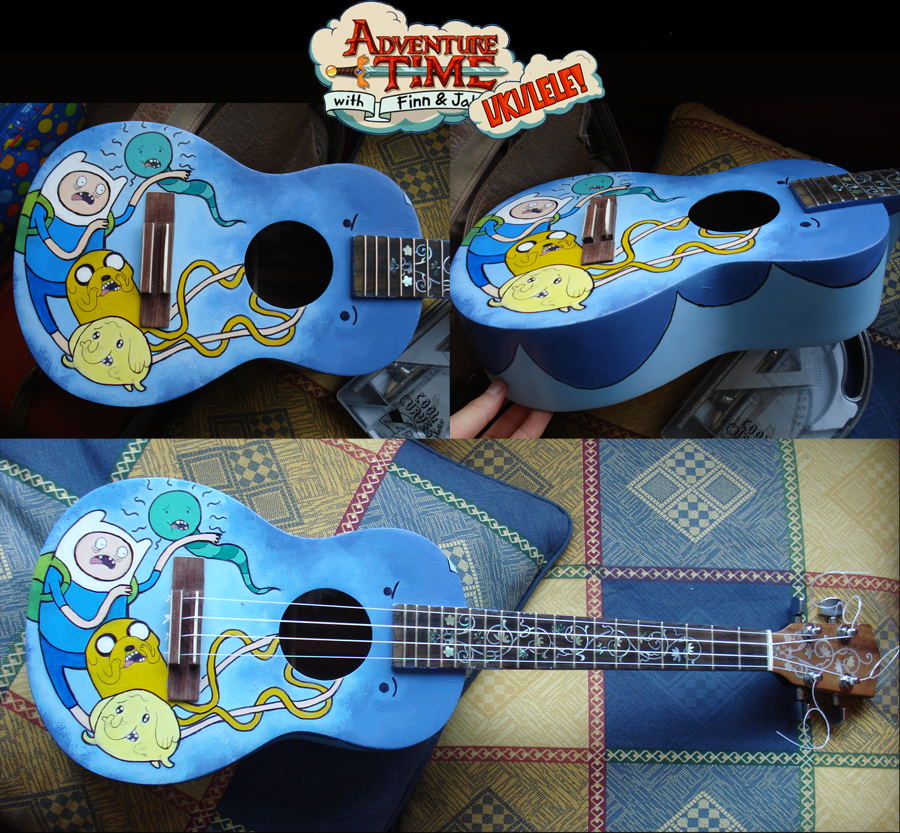
Besides being used as a musical instrument, some people use the surface of the ukulele as an art surface, handpainting the bodies in a multitude of styles and themes.  Here's one for a fan of the ADVENTURE TIME cartoon:

painted by Jenny7332 on deviantart.net

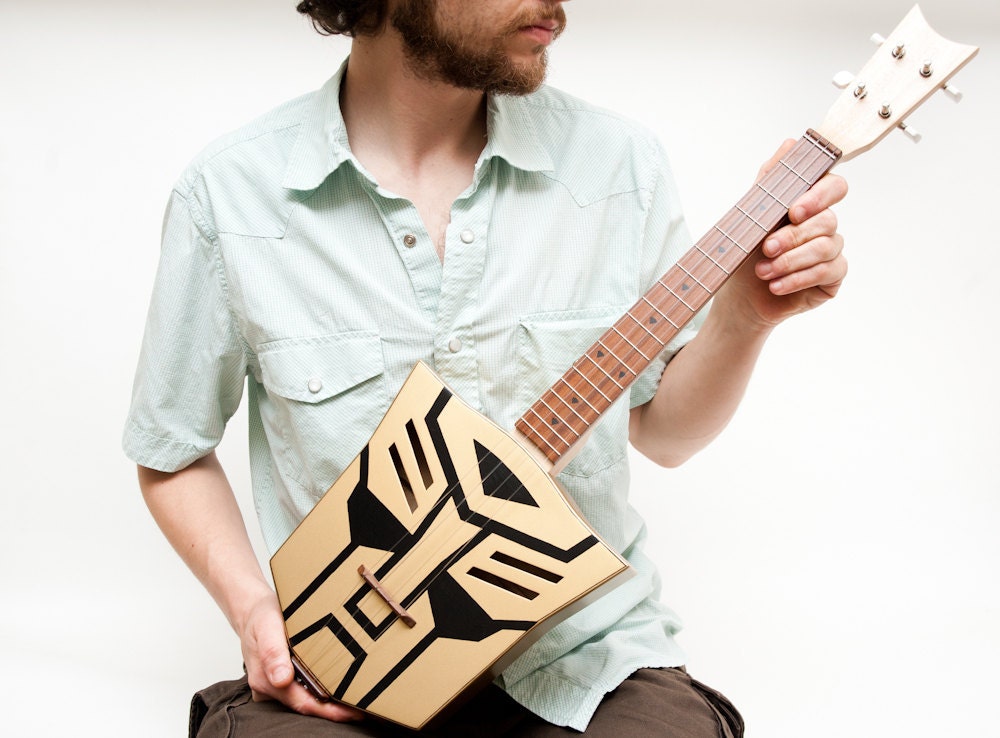
Some custom ukuleles have variant shapes.  There's actually an Autobot theme ukulele:

made by Celentano Woodworks

I gotta admit, tho', I'm not a big fan of Transformers, so that Autobot ukelele doesn't really excite me.  But with a bit more Googling, I found a ukulele that actually transforms.  Behold, the Folding Ukulele!:


The folding ukulele was designed by a guy named Brian Chan, who unsurprisingly is also an expert origamist.  It comes as a DIY kit made from laser-cut bamboo and additional hardware.  Reviews give it lower marks for sound quality, but the coolness factor is sky-high.

The weirdest ukulele, though, is probably a South American variant called a charango.  The charango's body is traditionally made from the shell of an armadillo:


Does all this mean you'll see me with a ukulele of some sort in the future?  Mmmmmm. . . maybe.  I would be a lot more likely to take it up in private, rather than public.  I'm not an extrovert, unlike some people:


That's John Scalzi, author of Old Man's War and other books, head honcho of the popular Whatever blog, and public ukuleleist.  I like John's writing, but I gotta admit I think I admire him most for his ongoing efforts to make being a goofball more socially acceptable.  Still-closeted goofballs everywhere thank you, John.


12/23/2012

Not My X-Rays, But Close

I still haven't seen the x-rays from my own broken arm, but the image below should be pretty close to what mine look like.  I'll put the image behind a break, because it's pretty cringe-worthy.

The technical term for my type of break is "comminuted".  (From Merriam-Webster:  being a fracture in which the bone is splintered or crushed into numerous pieces.  Yeah, that sounds appropriately painful.)

The nickname for how I shattered my arm is "a Superman break".  That's when a falling person puts out one arm like Superman's flying position to try and catch themselves.  Well, let's just stamp a big, fat FAIL over that manuveur, shall we?

(One of the mentally painful consequences of my fall has been the realization that I will never be a superhero.  Goddamit, "Become a superhero" has been on my To-Do list since I was a kid!  That sucks.  Really, really sucks.)


12/22/2012

Christmas and Mortality

Our son Chris has been working essentially two jobs up in Las Vegas, both his long-time dead-end job and his "externship" for the Phamaceutical Technician career he's trying to get into. (And doing well enough at that it's been suggested he should go for a full Pharmacist degree.  Yeah, maybe, if a big bundle of cash drops out of the sky and lands at his feet someday.  He's really stretching himself just to afford the PT courses.)

But that meant his schedule was supertight, and he could only make a quick half-day trip down here for Christmas, and only yesterday on the 21st.  It's been three or four years since he'd seen Grandma Shirley, my mother, but my brother Denny was gracious enough to drive Mom on short notice all the way from where's she's been living with his family near the eastern edge of Mesa.  (Or, as we call it way the heck over here in Glendale, "The Far Side of the Universe", about a 50-mile trip.)

My mother's 85, with a variety of health issues.  None critical right now, but... she's 85.  So it's probably a good thing to take advantage of any opportunity for her and Chris to see each other.  There's no reason to think this will be her last Christmas, but... she's 85.

This is one of the drawbacks of geting older:  You have to start taking into consideration the question, "If I don't do this now, will I have an opportunity to do it later?"

The accident that broke my arm certainly contributed to this morbid line of thought.  I've always known, intellectually, that I'll die someday.  But being hurt so badly, and so suddenly and unexpectedly, has really impressed on me, in a deep visceral sense, that I won't be here someday.  The thought struck me while Chris and Mom were here that someday there'll be a Christmas that will be my last Christmas.  (Though I certainly hope my timing will be better than my Dad's, who actually died on Christmas Day, 1980.)

This is not an easy concept to grasp, when it's one you've been trying to avoid all your life.  I'm not sure where this mental processing will end up, or whether going thru the process is the point.  We'll see.


This lovely graphic apparently comes from
a Moldavian animation company,
possibly as part of a commercial. 
(What were they advertising?) 
That's all I've been able to find out about it,
tho' I'd love to see the full animation someday.


12/15/2012

Broken News

Home from hospital Thursday night. More on that broken arm:

Not much to say about the accident itself.  It would be nice to be able to say it happened while defending the property at my security job from hordes of ninjas and zombies, but it actually was just a bad fall on a concrete sidewalk.  The sidewalk won.

The break, in the shaft under the head of the right humerus, produced enough pieces the doctors decided against trying to use plates and screws to put the bone back together.  So Tuesday afternoon the top part of the humerous was removed and a metal prosthesis put in its place.  I guess this now makes me an Official Cyborg.  When bandages are removed and scars healed, I will see if I can use any of our fridge magnets to stick a to-do list to myself.  (First entry on that list: "DON'T FALL")

If it sounds like I'm trying to make light of the situation, it's because a totally serious account would read something like this: "AIIIEEEEE!!!!  AIIIIEEEEEEE!!!!  AIIIIIIIEEEEEEEEEEEE!!!!!!!!"  God damn, that hurt.  That hurt.  That hurt.  Every time the arm moved, it hurt like jagged pieces of broken bone were trying to cut their way further into already-traumatized tissue.  Oh, wait....

It didn't help that in the day between accident and surgery, every separate x-ray or catscan -- at least half a dozen -- seemed to require a separate trip down to radiology, with each requiring at least one painful shift from gurney or bed to x-ray table or CT machine, then back again.  AND with shifters who didn't seem too concerned about my screams when those shifts took place.  (You might think it just couldn't be avoided, but the guy who took my pre-op chest x-ray managed to shift me carefully and cautiously.  It wasn't painless, but it was a lot LESS painless than everyone else's transfers.  A LOT less painless.  Thank you, Brian; thank you, thank you, thank you.  That hospital should have you teaching your techniques to the other employees; I'm serious about that.)

Less pain, but still quite a bit, post-surgery.  Like my rotator-cuff-surgery recovery a few years ago, I'll be in a sling and with that arm mostly out of use except for physical therapy for some weeks to come.  Since the injury was to my right arm this time, it will be even more inconvenient.  Financially at least, most should be covered by Workmen's Comp, and my private insurance hopefully taking care of the rest.

Mentally, I find myself more disturbed by this accident than I expected.  Part of the reason the bone broke so badly was that my 60-year old body is starting to show osteoporosis, with loss of bone strength.  Twenty years ago, I'd probably have bounced up from such a fall, maybe with abrasions and/or a sprained shoulder.  And, even after just a few days post-surgery, I can tell I'm recovering more slowly than after the rotator-cuff surgery only two years ago.  A few days after the cuff surgery, I was able to supervise a yard/estate sale for a lot of our deceased friend Anne's belongings.  A few days after breaking the arm, I'm still barely moving.  Just typing this one-fingered post is deeply wearying.

(There also seemed to be an unspoken attitude on the part of some of the medical personnel I was involved with this week: "Oh, he's an old guy.  When old people fall down, they break.  Situation normal."  No.  No, IT'S NOT NORMAL, DAMN YOUR UNCORRECTED 20-20 VISION EYES!)

I've always been fairly physically strong.  I've always known I had that reserve of strength to fall back on, even in periods of illness or injury.  But this is the first time I recall feeling not only weak and feeble, but fragile.

If we didn't have Tabbi, Hilde's live-in night-time caregiver when I'm at work, to step up and take more care of not only Hilde, but to assist me with day-to-day tasks while I'm recovering, we'd be screwed.  (We've had Tabbi living with us for seven years.  It's gotten to be a lot like having an adult daughter sharing the house.  She makes a good "daughter"; hurt her, and I'll break your arm.  Eventually.  I'll put it on a to-do list and stick it to my shoulder with a magnet until I'm recovered.)


BONUS VISUAL AID:  Barely noticeable painwise, but pretty spectacular visually, I also hit my face on the sidewalk when I fell.  I'm putting a photo below the break, in order not to frighten young or sensitive Internet users who might stumble across this post.

12/10/2012