1/10/2019

MY READING/LISTENING, 2018

2018 READING


(For some reason, the first line of each paragraph is longer than the rest. Looks okay on a desktop monitor, but on mobile that first line continues off-screen to the right. Attempts to correct it haven't succeeded. Other formatting glitches and idiosyncrasies have been cleaned up, I'm pretty sure.)

My reading in 2018 was as usual a mixed bag, mostly fiction and some non-fiction, ranging from works published in the last few years to work from decades ago. Some I read in printed editions, others in digital format on my smartphone. A fairly large number were listened to as audiobooks.

(My workplace allows listening to music or audiobooks so long as one ear is left unobstructed; so a Bluetooth earpiece lets me add an extra book to my “reading” about every one to two weeks.)


I also listen to a pretty large number of fiction podcasts, but that adds up to somewhere around 400-500 short stories a year, and read probably around half a dozen or so short story anthologies above and beyond that. I haven’t kept lists of those like I have longer works. If I manage to somehow get myself super-organized in the coming year, I might maintain a list of podcasts and stories I particularly enjoy.

Podcasts I listen to: Lightspeed, Clarkesworld, Nightmare, Strange Horizons, Uncanny, Beneath Ceaseless Skies, Toasted Cake and (under the Escape Artists umbrella) EscapePod, PodCastle,and PseudoPod. 2018 also saw the return of Norm Sherman’s Drabblecast (“Strange stories by strange authors for strange listeners”), which I’ve found highly enjoyable. Outside the dedicated SF/F/H podcasts, I also listen to the mystery podcasts from Alfred Hitchcock and Ellery Queen magazines, the New Yorker’s The Writer’s Voice, the BBC’s Drama of the Week, and Levar Burton Reads. (Burton chooses a fairly large share of SF/F stories to read, but not exclusively.)


A complete reading list for 2018 will be below, but the following were books I particularly enjoyed:

DAUGHTER OF MYSTERY by Heather Rose Jones was probably my favorite of 2018. Some books and writers get buzz and reputation by emphasizing one particular aspect of storytelling; plot, setting, characters, worldbuilding. What particularly struck me about DOM was how well balanced all those aspects were. Every page of this swords-and-manners (with Fantasy Lite aspects) story ran smoothly; it allowed me to fall fully into the story, to not be aware there was a writer pulling strings behind everything. Excellently done, and I have several more of Jones’ books in my TBR pile now.

A pair of outstanding novellas, THE ARMORED SAINT and THE QUEEN OF CROWS, came from Myke Cole in 2018, the first two parts of a trilogy. Medieval-style setting with a brutal theocracy that will straight up murder individuals or entire towns suspected of  being tainted with deviltry. A young woman, Heloise, comes into possession of a suit of powered (via a steam-engine-like technology) armor and is reluctantly forced into revolt against the theocracy. Cole pulls no punches about the costs involved in such a revolt; lives are upended, homes destroyed, friendships betrayed, loved ones lost, even many who survive still suffer injury and maiming. The mental and emotional toll on Heloise and others is also brought out. One aspect of Heloise’s world that Cole hasn’t focused on so far is that the “devils” are real, ripping into our world (literally, through the bodies of the possessed) and wreaking murderous havoc; so the theocracy, despite its brutality and corruption, actually is protecting the world from chaos. If Heloise’ revolt is successful, what would replace the theocracy and its protection? Perhaps that question will be one of the complications in the forthcoming final part of the trilogy.


  • Some other books I read with notably grim, violent settings and situations included:TRAIL OF LIGHTNING by Rebecca Roanhorse. In an altered America where gods and magic have returned to Native American lands, monsters have returned as well. A young woman raised by a demigod to hunt and kill monsters has to deal with outsider and abandonment issues, plus past trauma. She serves the People, but is not fully one of them.
  • THE STARS ARE LEGION by Kameron Hurley. I will confess, I found the cosmology of Hurley’s universe in TSAL difficult to grasp. But it seems in the far, far future when much of the natural universe has gone cold and dark, there are enclaves of created systems and planets, with almost continuous war between planets for scarce and dwindling resources. Life is struggle on both larger and smaller scales, and ruthlessness is a virtue and a necessity. I found the book engrossing regardless, in part because the society and background were so mysterious and disturbing.
  • UNDER THE PENDULUM SUN by Jeanette Ng was another book where the background and society were uncertain, but in this case that uncertainty is an integral and deliberate part of the book. The lands of Fae are real, reachable by ships that have found themselves lost upon the sea. Ways to become deliberately lost enable a measure of trade and commerce with the Fae. In addition to such commercial interests, missionaries travel to the Faelands to try to convert the heathen Fae to Christianity, with exceedingly rare success. The sister of one such missionary follows him to Fae, where she finds the “reality” of Fae lands is very flexible indeed, an uncertainty matched only by the (malicious?) fickleness and mystery of the Fae themselves. This is a grimness of the mind, and both brother and sister find their own weaknesses, exacerbated by the strange and uncertain land and beings around them, lead them into unwise actions and decisions.
  • Another work of psychological grimness is FORTRESS AT THE END OF TIME by J.M. McDermott. “Travel” between stars is accomplished by sending data to duplicates a person’s body and mind at the receiving end; from the original’s viewpoint nothing has happened but the duplicate will spend the rest of its life at the destination point. FATEOT takes place in a military space station orbiting a harsh planet at the ass-end of nowhere, listening for signs of an alien enemy that may never come. I caught notes of Dostoevsky, Kafka and Joseph Conrad in the style and narrative, though McDermott cites THE TARTAR STEPPE by Dino Buzzati and THE OPPOSING SHORE by Julian Graq as the major influences.

If you haven’t guessed by now, I don’t mind grim in my reading. (Though I don’t really like the term “grimdark”; somehow, for me, the term seems just a bit coy and… twee?)


Less grim, but with plenty of more traditional action and political maneuvering:
  • MEDUSA UPLOADED by Emily Devenport
  • THE TIGER’S DAUGHTER by K. Arsenault Rivera
  • BEHIND THE THRONE by K.B. Wagers
  • A DARKER SHADE OF MAGIC, by V.E. Schwab
  • BINTI by Nnedi Okorafor
  • THE ACCIDENTAL WAR, by Walter Jon Williams

In a lighter tone, I enjoyed Marshall Ryan Maresca’s LADY HENTERMAN’S WARDROBE, second in his “Streets of Maradaine” series. Think the tv series LEVERAGE set in a well-developed fantasy world and city. (Maresca has several other series, with different characters and premises, set in Maradaine.) When their neighborhood is burned out by arson (in the first volume, THE HOVER ALLEY CREW), a group of criminals and former criminals join together to try and find out the reasons and perpetrators behind the devastating fire. Break-ins, chases, disguises and deceptions ensue. As is common for breakneck caper stories, the clever plans only work until Something Goes Wrong, with a mad scramble to improvise their way out of disaster quickly following. Very enjoyable and well-written.


Among the stories in THE PEOPLE’S REPUBLIC OF EVERYTHING, a collection by Nick Mamatas, I particularly enjoyed the short novel “Under My Roof”. wherein a suburban father builds a DIY nuclear bomb, then declares his house and the lot it stands on a separate country. The absurdity is further heightened by the family’s young son, secretly a powerful mind-reader whose wry sardonic commentary on the real thoughts and motives of other characters adds much to the comedy.


Among the older books I read or re-read in 2018 was Walter M. Miller Jr.’s A CANTICLE FOR LEIBOWITZ. There’ve been a number of online discussion and essays the last decade or so over how many of the “Classic” SF or fantasy works are still exemplary or at least satisfying, and how many have been visited by the Suck Fairy upon reading in the present day. (Heinlein’s name and works tends to be mentioned a lot in those discussions.) Re-reading CANTICLE after about fifty years, I found it held up very well. Basic premise, for any I’d-lose-at-Jeopardy people reading this: Three linked novellas, roughly 600, 1200 and 1800 years after a nuclear war (the “Flame Deluge”) devastates Earth, followed by social upheaval among survivors that destroys most remaining knowledge and technology. Each story centers around the monastery of the Blessed (later Saint) Leibowitz, where a relative few salvaged shreds of knowledge, documents and books have been preserved and copied and re-copied for centuries.  Each section deals with how the monastery, and the beliefs and faith of the monks doing its work, react to game-changing developments: a trove of pre-nuclear documents, some relating directly to the life of Leibowitz, is discovered; six centuries later, science and technology are making a comeback, but threatened by the return of large nation-states and large-scale war; and, in the final section, science has advanced past the level existing before the Flame Deluge, making space travel a possibility, but also enabling the return of nuclear weapons which may destroy the Earth a second and final time before generation ships can establish new human footholds on other planets. Miller’s characters deal with doubt and uncertainty about their choices and beliefs in a dangerous and risky world. No Suck Fairy here.

Most of my reading is in the SF or Fantasy genres, but I also read occasionally in other genres, particularly mysteries and suspense. An older mystery I enjoyed was Philip Kerr’s 1989 MARCH VIOLETS. Set in 1930’s Germany when the Nazi party was consolidating its hold over German society, a private detective has to navigate corrupt bureaucracies and police, and the criminal underworld, in the course of investigating a murder and theft. Reading about the gradual normalization and acceptance of Nazi programs and atrocities was disturbing, not least because the events and history portrayed in Kerr’s novel parallel in many ways the actions of America’s own Trump administration.

Jordan Harper’s debut suspense novel SHE RIDES SHOTGUN was a thrill ride of a story. A somewhat ambivalent member of a white power prison gang, days before his scheduled release, has to kill one of the other members in self-defense. (Harper doesn’t go deeply how much his protagonist really buys into the white supremacist mindset -- in large part because for most of the book simple survival is the top and only priority --  but it seems he signed on primarily because in prison you either belong to a gang or you’re prey.) In result, a “kill order” is issued (including to members outside the prison) not only on him, but also on his entire family, the ex-wife and daughter left behind when he entered prison. He walks out of prison barely in time to avoid dying there, isn’t able to save his ex-wife but swoops up his pre-teen daughter just as she gets out of school. It’s a race to stay ahead of an entire gang focused on murdering them. When it becomes clear the pursuit will not stop until he and his daughter are dead, the decision is made to stop running away and fight back. To do that, he had to teach his daughter how to fight, how to shoot, how to kill. The bond between father and daughter, negligible at first, grows throughout the process and training. But what is that training doing to the girl’s bonds and relationship with society at large?

Two non-fiction books I particularly enjoyed:

ASSASSINATION VACATION by Sarah Vowell. I actually listened to the audiobook by mistake, having borrowed it from Overdrive having somehow thought it was a theme anthology of crime stories. No, actually it’s Vowell’s travelogue of sites relating to Presidential assassinations, with lots of interesting history and trivia along the way. But it’s also at times hilariously funny, because of Vowell’s self-deprecating humor. (She recognizes being obsessed with assassinations is a Pretty Freaking Weird hobby.)

UNDER THE RED SEA SUN by Edward Ellsberg. In 1942, the essential port of Massawa in Eritrea on the Red Sea was taken from the Italian forces that had occupied it, but not before the Italians blocked the port’s use by scuttling and booby-trapping numerous ships and the on-shore shops and facilities. Ellsberg, a maritime salvage expert was given the “impossible” task of reclaiming the port for use by the Allies, but with virtually no men, no equipment and no money, further complicated by corruption and incompetence in the military and civilian bureaucracies. A fascinating memoir of resourcefulness and ingenuity in the face of nearly overwhelming obstacles.


Full list for 2018:


JANUARY
Company of Lies, Karen Maitland
The Great West Detective Agency, Jackson Lowry (Robert Vardeman)
The Stars Are Legion, Kameron Hurley
Jane Steele, Lindsay Faye
The Wrong Stars, Tim Pratt


FEBRUARY
The Darkest Part of the Forest, Holly Black
Artemis, Andy Weir
Daughter of Mystery, Heather Rose Jones
Fortress At the End of Time, J.M. McDermott
Voyage of the Basilisk, Marie Brennan


MARCH
Rosemary and Rue, Seanan McGuire
Bitter Greens, Kate Forsyth
The Moving Target, Ross MacDonald
Lady Henterman's Wardrobe, Marshall Ryan Maresca
Altered America, Cat Rambo
Station Eleven, Emily St. John Mandel
Quillifer, Walter Jon Williams


APRIL
Assassination Vacation, Sarah Vowell
Before I Fall, Lauren Oliver
Gone Girl, Gillian Flynn
The Starlit Wood, Ed. Wolfe & ???


MAY
Beneath the Sugar Sky, Seanan McGuire
Hunger Makes The Wolf, Alex Wells
Aegypt, John Crowley
Alternate Routes, Tim Powers
Matchup, ed. Lee Child
She Rides Shotgun, Jordan Harper
The Armored Saint, Myke Cole


JUNE
The Serpent of Venice, Christopher Moore
Dogs Don't Lie, Clea Simon
March Violets, Philip Kerr
Medusa Uploaded, Emily Devenport
Hall of Heroes, ed. Fellowship of Fantasy


JULY
A Fierce Radiance, Lauren Belfer
The Tiger's Daughter, K Arsenault Rivera
Last Hope Island, Lynne Olson


AUGUST
The Paper Menagerie, Ken Liu
Behind the Throne, K.B. Wagers
Binti, Nnedi Okorafor
SPQR, Mary Beard
The City Stained Red, Sam Sykes
Stone Mad, Elizabeth Bear


SEPTEMBER
Night Has A Thousand Eyes, Cornell Woolrich
Sparrow Hill Road, Seanan McGuire
Trail of Lightning, Rebecca Roanhorse
A Darker Shade of Magic, V. E. Schwab
The Accidental War, Walter Jon Williams


OCTOBER
Trouble Is My Business, Raymond Chandler
Akata Witch, Nnedi Okorafor
Selections from Dreamsongs, Vol. 1 (audio), George RR Martin
The Cobbler's Boy, Elizabeth Bear & Katherine Addison
The Lucky Stiff, Craig Rice
The Ballad of Black Tom, Victor Lavalle
Under the Red Sea Sun, Edward Ellsberg
The Queen of Crows, Myke Cole


NOVEMBER
Space Opera, Cat Valente
Wayward Saint, J.S. Morning
Penric's Demon, Lois McMaster Bujold
The People's Republic of Everything, Nick Mamatas
How To Stop Time, Matt Haig
Gallows View, Peter Dickinson


DECEMBER
Dreadnought, Cherie Priest
Amberlough, Lara Elena Donnelly
Under the Pendulum Sun, Jeanette Ng
A Canticle For Leibowitz, Walter M. Miller Jr.
Forty Thieves, Thomas Perry
The Anubis Gates, Tim Powers


And by author:


The Cobbler's Boy, Elizabeth Bear & Katherine Addison
Stone Mad, Elizabeth Bear
SPQR, Mary Beard
A Fierce Radiance, Lauren Belfer
The Darkest Part of the Forest, Holly Black
Voyage of the Basilisk, Marie Brennan
Penric's Demon, Lois McMaster Bujold
Trouble Is My Business, Raymond Chandler
Matchup, ed. Lee Child
The Armored Saint, Myke Cole
The Queen of Crows, Myke Cole
Aegypt, John Crowley
Medusa Uploaded, Emily Devenport
Gallows View, Peter Dickinson
Amberlough, Lara Elena Donnelly
Under the Red Sea Sun, Edward Ellsberg
Jane Steele, Lindsay Faye
Hall of Heroes, ed. Fellowship of Fantasy
Gone Girl, Gillian Flynn
Bitter Greens, Kate Forsyth
How To Stop Time, Matt Haig
She Rides Shotgun, Jordan Harper
The Stars Are Legion, Kameron Hurley
Daughter of Mystery, Heather Rose Jones
March Violets, Philip Kerr
The Ballad of Black Tom, Victor Lavalle
The Paper Menagerie, Ken Liu
The Great West Detective Agency, Jackson Lowry (Robert Vardeman)
The Moving Target, Ross MacDonald
Company of Lies, Karen Maitland
The People's Republic of Everything, Nick Mamatas
Lady Henterman's Wardrobe, Marshall Ryan Maresca
Selections from Dreamsongs, Vol. 1 (audio), George RR Martin
Fortress At the End of Time, J.M. McDermott
Beneath the Sugar Sky, Seanan McGuire
Rosemary and Rue, Seanan McGuire
Sparrow Hill Road, Seanan McGuire
A Canticle For Leibowitz, Walter M. Miller Jr.
The Serpent of Venice, Christopher Moore
Wayward Saint, J.S. Morning
Under the Pendulum Sun, Jeanette Ng
Akata Witch, Nnedi Okorafor
Binti, Nnedi Okorafor
Before I Fall, Lauren Oliver
Last Hope Island, Lynne Olson
The Starlit Wood, ed. Dominik Parisien & Navah Wolfe
Forty Thieves, Thomas Perry
Alternate Routes, Tim Powers
The Anubis Gates, Tim Powers
The Wrong Stars, Tim Pratt
Dreadnought, Cherie Priest
Altered America, Cat Rambo
The Lucky Stiff, Craig Rice
The Tiger's Daughter, K Arsenault Rivera
Trail of Lightning, Rebecca Roanhorse
A Darker Shade of Magic, V. E. Schwab
Dogs Don't Lie, Clea Simon
Station Eleven, Emily St. John Mandel
The City Stained Red, Sam Sykes
Space Opera, Cat Valente
Assassination Vacation, Sarah Vowell
Behind the Throne, K.B. Wagers
Artemis, Andy Weir
Hunger Makes The Wolf, Alex Wells
The Accidental War, Walter Jon Williams
Quillifer, Walter Jon Williams
Night Has A Thousand Eyes, Cornell Woolrich

8/29/2018

Update to "The New Normal: Living Under the Sword of Damocles"

Back in May, I wrote a post, "The New Normal: Living Under the Sword of Damocles", detailing medical issues that posed a potentially fatal danger for my wife Hilde. At that time, we were postponing surgery until further developments made the situation even more critical. (Failing sections of cervical reconstruction hardware from a 2001 surgery had shifted to where there was a large lump and a pinhole-sized tear on the back of her neck, creating a potential entry point for spinal cord or brain infection.)

That "further development" happened in June, when further shifting enlarged the tear and allowed actual metal to come out through Hilde's neck skin.

(I have photos I took to let Hilde see what was happening back there, but they're kind of alarming -- "Oh  shit, your wife is a Terminator! Run, Bruce, run!" -- so I won't post any. The full piece of hardware was several inches long and about the width and thickness of a popsicle stick, but only about 3mm of the tip projected outside her skin. That was plenty alarming, though, he understated.)

So... more x-rays, tests, consultations with her doctors at Mayo, etc. While those were going on, we kept the wound slathered with antibiotic ointment and covered with a dressing; super-stretchy surgical tubing, worn like a headband, kept the gauze pad in location on the awkward spot.

We also used the weeks while a surgical plan was developed to try to prepare for the worst possible outcomes. We had our wills updated, set up a living trust for our property and possessions, and had Durable Power of Attorney and Advanced Medical Directives drawn up so decisions could be made and documents signed in the event of our incapacitation. (This was all stuff we should have gotten done much sooner, but I guess it took a medical crisis to build our motivation to critical mass. Don't wait 'til the last moment yourself, folks!)

The Plan B for surgery that eventually developed was less drastic than originally envisioned. The original plan intended to remove most or all the failing hardware, but this would also leave Hilde's neck and spinal column in a precarious condition, likely to eventually fail and result in quadriplegia and/or death.

Plan B was to leave most of the hardware "Abandoned In Place". The actual projecting piece of metal (and its matching piece on the right side of Hilde's neck, which was close to coming through the skin there) would be trimmed back as far as was safe, a plastic surgeon would take a thin flap from the trapezius muscle and place it over the surgical area (this increases blood flow and promotes healing; it was expected that Hilde's normal wound recovery ability would be compromised by years of steroid medications), and the wound closed.

Plan B would mean a shorter time in surgery, less trauma to her body, and *some* reduction in risks and complications. Less chance of the neck destabilizing post-surgery, for one. But the neurosurgeon's primary concern was over the stenosis in Hilde's cervical spine (the "dog-leg turn" I mentioned in the May post) that was already putting pressure on her spinal cord in several places; her fear was that anesthesia might cause Hilde's blood pressure to crash, reducing blood flow to the already restricted parts of the spinal cord and starving it of oxygen, which might still result in quadriplegia or death. So... less risky, but still a high-risk surgery.

The Plan B surgery took place, yesterday, August 28th. Let's skip any more suspense: the surgery was successful; Hilde came out of it awake and aware and without losing the rest of mobility and movement she has left after fifty years of rheumatoid arthritis.

Not without a few moments of drama, though. When Hilde was turned over for the surgery, the crash in blood pressure the neurosurgeon had feared began to occur. But they were able to reposition her and get the BP back up to acceptable levels before any permanent damage occurred, and the rest of the operation went smoothly. The trapezius-flap procedure was left undone; Hilde's skin and muscle tone looked better than expected and skipping the procedure shortened the time in surgery and reduced the possibility of further blood pressure problems.

So... it looks like we'll end up with a reset to the end of last year, before the skin tear developed. This is, to put it very lightly, a relief. But the months of anxiety and dread (at least on my part; Hilde was stoic, I was terrified) came with a few lessons:

Most importantly, get your affairs and papers in order now. Even though this was a slowly building crisis, one that gave us months to try and prepare for the worst, there's always things you'll forget or not get done. Spending part of last weekend drawing up a list of people to notify if Hilde died in surgery was not a fun activity, but one that had to be done. If this had developed as a sudden emergency, we'd have been much more unprepared.

I'd probably have been more efficient at preparing for the worst if I hadn't resisted taking anti-anxiety medication. There were so many times I felt close to panic; it's hard to focus when your mind keeps going "What if...? What if...? What if...?" and it feels like a pile of rocks is sitting on your chest.

Thanks to everyone who gave us their best wishes and hopes during this time.

5/08/2018

The New Normal: Living Under the Sword of Damocles

Over on Twitter during the last several months, I've made several vague allusions to "medical issues" Hilde and I have been dealing with. Those issues have reached a point of (current) stability that I finally feel able to write about.

Hilde's had severe Rheumatoid Arthritis for fifty years, since she was 22. The RA has worn at and worn down her body and ability to use it ever since, and has made her become progressively more and more disabled and dependent.

Back in 2001, the RA looked like it might literally kill her. Her C-1 vertebrae, at the top of the spine, had degraded to the point it was beginning to break apart, allowing her skull and brain to begin moving downwards. In the neurosurgeon's memorable phrase, her brain would be "pithed like a laboratory frog". Without reconstructive surgery, he estimated her life expectancy as two weeks to six months (but most of that six months would be as a brain-damaged quadriplegic). The surgery itself was not without risk, with a 1-in-7 chance of dying on the operating table.

That surgery was done, Hilde survived, and for seventeen years her neck has been held together with wires and rods and screws. Her neurosurgeon has said most people who have that type of operation gain another 2-5 years of life, so she's beaten those odds several times over. (When we've seen the neurosurgeon every few years for follow-ups, we get the impression he'd like to put Hilde in a big glass box and take her to medical conferences to show off to other doctors.)

BUT... when hardware's been in a body that long, things happen. It degrades. It shifts. It breaks.

About 7-8 years ago, Hilde began to get a couple of small lumps on the back of her neck. X-rays revealed some of the surgical screws were slowly working their way loose and trying to back out of their holes. We were advised that it was something to keep an eye on, but not anything critical or dangerous at that point. We had another follow-up in 2015, when the lumps had gotten slightly larger. At that appointment, we were told that a second reconstructive surgery would be much more dangerous, with only 50/50 odds of surviving the operation. We were advised that unless the shifting hardware got to the point where it punctured the skin and provided a potential entry point for spinal cord or brain infections, surgery probably shouldn't be considered an option.

That point was reached in late January of this year; one of the lumps on Hilde's neck had increased in size dramatically over the previous month or so, stretching the skin to the point that a small tear, about pinhead size, opened up.

So, since then, we've been doing our best to keep that opening clean and free of infection, treating it daily with antibiotic ointment, while we've been consulting the neurosurgery department at the Phoenix branch of the Mayo Clinic. (Hilde wants any future surgeries done at Mayo because the quality of care is much higher than other hospitals -- like, a lot -- she's been in over the years.)

The findings from x-rays, cat scans, MRIs, bone density scans, etcetera, have been... not good.

Essentially, by this point, all the hardware in Hilde's neck has failed, coming loose or broken, and what's probably continuing to hold Hilde's neck together is the scar tissue from the 2001 surgery. To go in to remove the failed hardware would entail cutting through that scar tissue, probably resulting in further destabilization of the neck and spine, leading to further complications ranging from chronic neck pain to quadriplegia to death.

Further, Hilde's bone density (after fifty years of RA and steroid meds) is officially osteoporotic, and the Mayo surgeon feels attempting to install fresh hardware would either fail quickly or possibly be unable to do at all.

Plus... the MRI showed that Hilde's upper spine, rather than being a smooth curve, has a slight dog-leg bend (something like the dog-leg chisel shown at this link) that's already putting compression on her spinal cord in two places. Dealing with that would be a further complication and increased risk for surgery.

So... the recommendation has been to not attempt surgery at this point, but to continue treating the skin break on Hilde's neck and avoid infection. Which is what we're doing.

But at some point, Something Will Happen. A germ might get lucky and start an infection despite our efforts. More of Hilde's internal hardware will move and shift and create a critical situation. That compression on Hilde's spinal cord might increase and create its own crisis. At that point, assuming Hilde survives whatever critical failure occurs, postponing surgery may not be an option. And, if she survives that surgery, it's very uncertain what quality or how long a life she might have afterwards.

So that's our New Normal.

(Added: This has been the Biggest Bad in our lives since January. Hilde's also had a slew of other, unrelated issues since November, including two hospital stays, hearing problems, and losing the remaining functionality in her left arm, which last has left her unable to hold or read printed books anymore. She also can't use touchscreens or a mouse to use an ereader, so she's currently feeding her book jones with audiobooks that I or Tabbi start or stop for her. There's a new control-with-head-movements program that looks like it might make it feasible for her to use a tablet, but it's been difficult and frustrating for her to try and learn.)

4/04/2018

2017 reading

I've been keeping lists of books I've read (or listened to on audiobook) for a few years. Here's gthe list from 2017, both by month read and by author. Some comments/mini-reviews for ones I particularly liked are after the lists.

JANUARY
In the Garden of Iden, Kage Baker
Three Bags Full, Leonie Swann (murder mystery from the PoV of a herd of sheep; surprisingly, it works)
Bellwether, Connie Willis
In Sunlight or In Shadow, Lawrence Block (ed.)
Monstress, Marjorie Liu (graphic novel)
Pirate Utopia, Bruce Sterling
Slayground (a "Parker" novel), Richard Stark (ps. Donald Westlake)
Impersonations, Walter Jon Williams

FEBRUARY
Martians Abroad, Carrie Vaughn
Plunder Squad (a "Parker" novel), Richard Stark (ps. Donald Westlake)
Dreadnought, April Daniels
The Unbeatable Squirrel Girl: I Kissed A Squirrel and I Liked It, Ryan North & Erica Henderson (and others)
The Unbeatable Squirrel Girl Beats Up The Marvel Universe, Ryan North & Erica Henderson
Valentine Pontifex, Robert Silverberg
Butcher's Moon (a "Parker" novel), Richard Stark (ps. Donald Westlake)
Crooked Heart, Lissa Evans
The Hipster From Outer Space, Luke Kondor

MARCH
Faceoff, ed. David Baldacci (teamup stories between popular thriller characters)
Caliban's War (The Expanse #2), James S.A. Corey
We Are All Completely Beside Ourselves, Karen Joy Fowler
I Shudder At Your Touch, ed. Ellen Datlow (abridged audiobook)

APRIL
Abaddon's Gate (The Expanse #3), James S.A. Corey
Get In Trouble, Kelly Link
Code Name Verity, Elizabeth Wein
Lovecraft Country, Matt Ruff
A Knight of the Seven Kingdoms, George RR Martin

MAY
Jamrach's Menagerie, Carol Birch
The Unbeatable Squirrel Girl 5: Like I'm the Only Squirrel In the World, Ryan North & Erica Henderson (and others)
Colonel Roosevelt, Edmund Morris
Angst, David J. Pedersen
A Hundred Thousand Possible Worlds, Bob Proehl
The Holver Alley Crew, Marshall Ryan Maresca

JUNE
The Plague Dogs, Richard Adams
The Service of the Dead, Candace Robb
The Outsider, Fredrick Forsyth
Tropic of Serpents, Marie Brennan

JULY
A Closed and Common Orbit, Becky Chambers
Whispers Underground, Ben Aaronovich
Forever and A Death, Donald Westlake
All Systems Red, Martha Wells
The Drop, Dennis Lehane
Indigo, Charlaine Harris, et al.

AUGUST
Comeback (a "Parker" novel), Richard Stark (aka Donald Westlake)
Arsenic With Austen, Katherine Bolger Hyde
Gwendy's Button Box, Stephen King & Richard Chizmar
Six Wakes, Mur Lafferty
Sovereign, April Daniels
Northhanger Abbey, Jane Austen
Backflash, (a "Parker" novel), Richard Stark (aka Donald Westlake)

SEPTEMBER
Tremontaine, Ellen Kushner, et al.
Duma Key, Stephen King

OCTOBER
The Strange Case of the Alchemist's Daughter, Theodora Goss
Flashfire (a "Parker" novel), Richard Stark (aka Donald Westlake)
Firebreak (a "Parker" novel), Richard Stark (aka Donald Westlake)
The Bad Beginning (A Series of Unfortunate Events, Vol 1), Lemony Snicket
Strange Beasties, ed. Juliana Rew

NOVEMBER
Meddling Kids, Edgar Cantero
Buffalo Soldier, Maurice Broaddus
The Reapers Are The Angels, Alden Bell
The Broken Sword, Poul Anderson

DECEMBER
Nightmare At 20,000 Feet: Horror Stories of Richard Matheson, Richard Matheson
Ancillary Mercy, Ann Leckie
The Wall of Storms, Ken Liu
The Book of Swords, ed. Gardner Dozois
The Adventure of the Incognita Countess, Cynthia Ward
The Bookseller, Cynthia Swanson
Final Girls, Mira Grant

- - - - -

SORTED BY AUTHOR:
  • Whispers Underground, Ben Aaronovich
  • The Plague Dogs, Richard Adams
  • The Broken Sword, Poul Anderson
  • Northhanger Abbey, Jane Austen
  • In the Garden of Iden, Kage Baker
  • Faceoff, ed. David Baldacci (teamup stories between popular thriller characters)
  • The Reapers Are The Angels, Alden Bell
  • Jamrach's Menagerie, Carol Birch
  • In Sunlight or In Shadow, Lawrence Block (ed.)
  • Tropic of Serpents, Marie Brennan
  • Buffalo Soldier, Maurice Broaddus
  • Meddling Kids, Edgar Cantero
  • A Closed and Common Orbit, Becky Chambers
  • Caliban's War (The Expanse #2), James S.A. Corey
  • Abaddon's Gate (The Expanse #3), James S.A. Corey
  • Dreadnought, April Daniels
  • Sovereign, April Daniels
  • I Shudder At Your Touch, ed. Ellen Datlow (abridged audiobook)
  • The Book of Swords, ed. Gardner Dozois
  • Crooked Heart, Lissa Evans
  • The Outsider, Fredrick Forsyth
  • We Are All Completely Beside Ourselves, Karen Joy Fowler
  • The Strange Case of the Alchemist's Daughter, Theodora Goss
  • Final Girls, Mira Grant
  • Indigo, Charlaine Harris, et al.
  • Arsenic With Austen, Katherine Bolger Hyde
  • Duma Key, Stephen King
  • Gwendy's Button Box, Stephen King & Richard Chizmar
  • The Hipster From Outer Space, Luke Kondor
  • Tremontaine, Ellen Kushner, et al.
  • Six Wakes, Mur Lafferty
  • Ancillary Mercy, Ann Leckie
  • The Drop, Dennis Lehane
  • Get In Trouble, Kelly Link
  • The Wall of Storms, Ken Liu
  • Monstress, Marjorie Liu (graphic novel)
  • The Holver Alley Crew, Marshall Ryan Maresca
  • A Knight of the Seven Kingdoms, George RR Martin
  • Nightmare At 20,000 Feet: Horror Stories of Richard Matheson, Richard Matheson
  • Colonel Roosevelt, Edmund Morris
  • The Unbeatable Squirrel Girl: I Kissed A Squirrel and I Liked It, Ryan North & Erica Henderson (and others)
  • The Unbeatable Squirrel Girl Beats Up The Marvel Universe, Ryan North & Erica Henderson
  • The Unbeatable Squirrel Girl 5: Like I'm the Only Squirrel In the World, Ryan North & Erica Henderson (and others)
  • Angst, David J. Pedersen
  • A Hundred Thousand Possible Worlds, Bob Proehl
  • Strange Beasties, ed. Juliana Rew
  • The Service of the Dead, Candace Robb
  • Lovecraft Country, Matt Ruff
  • Valentine Pontifex, Robert Silverberg
  • The Bad Beginning (A Series of Unfortunate Events, Vol 1), Lemony Snicket
  • Slayground (a "Parker" novel), Richard Stark (ps. Donald Westlake)
  • Plunder Squad (a "Parker" novel), Richard Stark (ps. Donald Westlake)
  • Butcher's Moon (a "Parker" novel), Richard Stark (ps. Donald Westlake)
  • Comeback (a "Parker" novel), Richard Stark (aka Donald Westlake)
  • Backflash, (a "Parker" novel), Richard Stark (aka Donald Westlake)
  • Flashfire (a "Parker" novel), Richard Stark (aka Donald Westlake)
  • Firebreak (a "Parker" novel), Richard Stark (aka Donald Westlake)
  • Pirate Utopia, Bruce Sterling
  • Three Bags Full, Leonie Swann (murder mystery from the PoV of a herd of sheep; surprisnigly, it works)
  • The Bookseller, Cynthia Swanson
  • Martians Abroad, Carrie Vaughn
  • The Adventure of the Incognita Countess, Cynthia Ward
  • Code Name Verity, Elizabeth Wein
  • All Systems Red, Martha Wells
  • Forever and A Death, Donald Westlake
  • Impersonations, Walter Jon Williams
  • Bellwether, Connie Willis
- - - - -

SOME OF MY FAVORITES OF THE YEAR'S READING:

  • The Broken Sword, Poul Anderson -- I first read this about fifty years ago, listened to the audiobook (narrated, very nicely, by Bronson Pinchot) recently. I had forgotten how well Anderson could evoke the rhythm, style and atmosphere of classic Norse saga.
  • The Reapers Are The Angels, Alden Bell -- You might think "Another furshlugginer zombie novel," but this is a particularly well-done example of the genre. YA protagonist, the story deals with the idea that to survive in a world largely devastated by monsters, people might themselves have to become monsters. And, when enclaves of normalcy begin to slowly reestablish, what place will there be for the monsters in human skin?
  • A Closed and Common Orbit, Becky Chambers -- I read Chambers' first book, The Long Way To A Small Angry Planet, but was not as bowled over by it as a lot of people; enjoyed that first book, but considered it "good" rather than great. I found this sequel kept my attention and interest to a much greater degree. An artificial intelligence meant to run a spaceship is implanted in a (highly illegal) human body; the story deals with her slow and sometimes rocky adjustment -- and how much it's possible for her to adjust -- to life in a new body and environment. The tighter focus on a smaller cast -- two main characters here, as opposed to the ensemble cast of The Long Way -- works to great advantage here, I thought.
  • The Outsider, Fredrick Forsyth -- I'm not sure I've ever read any of Forsyth's fiction beyond a collection of short stories. Nope, not even Day of the Jackal. But The Outsider, Forsyth's memoir of his life and surprising adventures, got such an enthusiastic reception I gave it a try. Good decision. Turns out Forsyth used some of his own experiences and wide-faring travels as springboards for many of his novels. Combined with the authorial voice of a great raconteur, the pages just keep turning on this one. I especially liked how Forsyth tied the ending, set in his 70's, back to his experience as a young boy.
  • We Are All Completely Beside Ourselves, Karen Joy Fowler -- This novel has a major revelation, a Big Surprise Twist that by the time I read the book was one I was already aware of. But that wasn't a spoiler for me, because that was only the plot element around which the story's themes revolved. Themes of perception, of how the stories we write in our heads are not always the true stories, of how what we want to be real is not always reality. The narrative reversals in the later parts of WAACBS left me going "Whoa-a-a...." Very impressive story, very impressive writing.
  • The Strange Case of the Alchemist's Daughter, Theodora Goss -- I like a lot of books that revisit old classics and put a new twist on them. Sometimes by writing a "Next Generation" sequel dealing with the children of the original work's  characters. Sometimes by doing a "mashup", putting characters from several classic works by several authors together in a new story. Theodora Goss does both in Alchemist's Daughter, with the daughters of Jekyll and Hyde, the Bride of Frankenstein, Rappaccini's Daughter, and panther-woman Catherine Moreau coming together for mutual support and to investigate and fight a common enemy. (Sherlock Holmes and company also play important parts in the story.) I especially liked the interactions between straight-laced Mary Jekyll and street-tough Diana Hyde; I was reminded of the odd-couple cop-pairings of Lethal Weapon and other movies. (I'd love to see the BBC make this as a movie or mini-series.)
  • Tremontaine, Ellen Kushner, et al. Set in the swords-and-manners world of Kushner's novel Swordspoint (though several decades earlier), this is one of the collaborative novels being published by Serial Box. (Multiple authors contributing sections of a novel--length story arc; very similar to the "braided novels" in the Wild Cards series.) Politics, romance, diplomacy, trade issues and, yep, swordfights mix in the telling. On occasion, stylistic differences between contributors are a bit jarring, but overall this was an engrossing tale, and I'm hoping to see more Tremontaine books.
  • Six Wakes, Mur Lafferty -- Murder mystery in space. The characters are travelers on a slower-than-light interstellar ship who only intermittently awake from suspended animation during the decades-long voyage. A side-effect of suspension is memory loss, but brain recordings can be reloaded on awakening. Problem: The woken find one of the crew very messily dead, and their memory downloads are from the earliest days of the voyage, with later recordings deleted. What happened during those missing years, and does the killer even know they're a murderer?
  • Ancillary Mercy, Ann Leckie -- Concluding volume of the "Imperial Radch" trilogy. Grand space opera. Breq, formerly part of the multi-bodied group mind that controlled and manned an Imperial warship, has been reduced to a single soldier who has to learn to survive as an isolated individual in a milieu of complicated politics and societies. The trilogy won numerous awards, and rightly so.
  • Lovecraft Country, Matt Ruff -- When it comes to Lovecraftian fiction, I can usually leave it or leave it. I read enough of HPL and his imitators when I was younger to know very little of it appealed to me. But Ruff's homage/rebuttal of Lovecraftian traditions was an exception. Lovecraft's casual/neurotic racism is countered by making the main characters black in 1950's America and having to deal with actual racism, segregation and human-sourced danger along with the supernatural elements. They also feel like very real characters; I particularly liked Letitia; if LC were a movie (it's being developed as a TV series), Letitia would be the action-hero character.
  • Butcher's Moon (a "Parker" novel), Richard Stark (ps. Donald Westlake) -- I've been a fan of the Parker novels (gritty crime stories about a career criminal and heist artist whose "professionalism" may be sourced in sociopathy)  for a long time, and have been catching up on volumes I hadn't read back in the day. For a long time, 1974's Butcher's Moon was the last Parker adventure (Westlake revived the character in 1997 for eight additional books before his death in 2008) and could be considered the grand finale of the series. Much longer than earlier volumes, the story hearkens back to plot elements of earlier books and eventually draws in numerous secondary characters from those books for a grand Magnificent Seven/Ocean's Eleven type of resolution. Great work by Westlake, balancing numerous plot elements and complications as well as a a large cast.
  • The Adventure of the Incognita Countess, Cynthia Ward -- like the Theodora Goss book mentioned above, this is a mashup of characters and ideas from a number of classic works. In 1912, Lucy Harker, half-vampire daughter of Mina Harker and Dracula, is a new government agent tasked with hunting and killing full-blooded vampires and "dhampirs". The British Empire is also in the midst of reverse-engineering and adapting the captured technology of the failed Martian invasion of some years previous. The adaptations include the powerful engines on the newly built, just launched Titanic (uh-oh), where Lucy encounters Carmilla, the pre-Dracula vampire from Le Fanu's novel of the same name. Complication: There is intense and mutual attraction between sexually-repressed Lucy and sensuous Carmilla. It all works itself out in a breakneck pulp-style romp that's a lot of fun. (And, once again  Sherlock Holmes is present in a major supporting role. I'm starting to think his middle name may be "Ubiquitous". This phenomenon has been especially notable since much of the Holmes canon was finally declared part of the public domain awhile back, with a virtual tidal wave of new Holmes mysteries in the classic style -- some well-done, some *koff* not -- from both traditional and indie publishers, or using Holmes as a secondary character as Goss and Ward have done. But at least Holmes homageurs no longer have to file off the serial numbers and give their look-and-feel imitations ridiculous names like, oh, Solar.)


10/13/2017

My Best True Cat Story


I’ve told this story in a few other places, but don’t think I’ve told it here:
Back in the early 80’s, our alpha cat was a big grey fluffy male who had been a stray around our first house. (Walked up and introduced himself: “Hey, you! Wanna house and feed the World’s Best Cat? Here I am.”) We usually try to keep our cats as indoor-only, but having lived on the street for a while, he insisted on occasional outdoor strolls.
We’d had him a few years, and had moved to a different neighborhood and house. One Sunday morning, as I was driving Hilde and our young son Chris to church, about a block away Hilde and I saw… a large grey fluffy cat, lying dead in the street with his head badly crushed.
Hilde and I exchanged looks as we drove slowly by, but didn’t want to upset Chris before church. So I drove them to church, then came back, retrieved the body, took it home, and buried it in the back yard, with a lot of tears. (He may not have been THE World’s Best Cat, but he was a contender.)
After Hilde and Chris got back home, we broke the news to Chris. More tears, more sadness.
We felt down all day, but had some out-of-town friends scheduled to visit that evening, so we bucked up and tried to put a good face for the visit, not mentioning the loss.
After dinner and chat, we took our visitors out on the back porch to see the hot tub we’d recently purchased. After a few moments, one of the visitors looked down into the shadows by the hot tub and said, “Oh, did one of your cats slip out with us?”
We looked down and saw… a large grey fluffy male cat. The same one we’d believed dead all day. The cat looked back up and meowed. (“Where’s my food?”)
We, of course, were overjoyed to see him so unexpectedly alive. Hugs and pets ensued. (Cat: “Whatever. Food?”) Then I realized…
…I had buried someone else’s cat.
Never found out where the dead lookalike cat had come from. Even now, decades later, I feel a bit guilty that somewhere a family’s cat disappeared and never came back, and they never found out what had happened to it.
But the punchline to our cat returning from the dead?
Our cat was named Aslan.

(Copied this from a recent comment I left on File 770. Aslan lived to be nearly 20 before he passed away for real. The pic above is from a free-image site; not the original Aslan, but pretty similar.)

6/22/2017

Book Review: THE SERVICE OF THE DEAD, Candace Robb


The Service of the Dead, Candace Robb (Pegasus Books, 2016)

Historical mystery, first in a new series set at the end of the 14th Century, during the struggle over whether the rightful king should be Richard II or Henry Bolingbroke.

Protagonist is Kate Clifford, a young widow in York struggling to continue her late husband's business and also renting several properties as guesthouses. An unexpected part of her husband's estate turns out to be two children by a secret French mistress, orphaned after their mother's own death; Marie and Philippe are left almost literally at Kate's doorstep. Kate also has to deal with servants, retainers, and various relatives, some trustworthy, some not. And some taking part in the political turmoil between Richard II and Bolingbroke, though choosing any side at all was a dangerous choice.

When a murdered man is discovered in one of Kate's guesthouses, a deadly game begins, as Kate tries to determine the man's turn identity and loyalties, and in how much danger that truth will place her. More murders will occur before that truth is found.

Kate, as a character, grew slowly for me, and early chapters felt slow as a result. As more of Kate's own backstory is revealed -- she was sent south into an English marriage to protect her from a Hatfields/McCoys-type feud on the Scottish borders where she was raised, even though she is herself skilled with knife and bow and axe -- she became more interesting, and the book more enjoyable.

In some ways, this book feels almost like a prequel, introducing and setting up the gameboard and pieces that will be played in future volumes. (The second book in the series, A Twisted Vengeance, is out.) That setting-up process felt slow in the beginning, but sped up satisfactorily by the end. I'll give it four stars out of five.

(Won in a Goodreads Giveaway.)

2/28/2017

Pantsing A Story

"Of all the demons in hell, there is none I dread more than Revision." -- A. Everett Beek

So, been working on a new story. Usually, when I'm writing fiction, I've got a moderately good plot-line planned out in my head. Not quite an outline, but at least a cocktail-napkin style sketch of how a story will progress.

This time, though, I started out with a particular scene, with no clear idea of backstory, present story, or where the story was going. This sort of thing is usually described as a "discovery" story, or as "writing by the seat of your pants" (aka "pantsing"). With that technique, you just start writing and free associating and see where the story takes you.

Sometimes that works out well. And sometimes....

I'm about five thousand words into the story, and what I'm discovering is that the story seems to be developing more and more problems the further I go with it. As in:

  • When I started, I wanted this story to be done by the 5000 word mark. It's maybe half-done. Maybe.
  • The central character is a naive fool, and the other characters are liars, crooks, and a religious fanatic. The more I write, the less I like them. The only really appealing character so far is a very minor one.
  • One of the most important characters isn't in the story at all. He died before the starting point of the story, but what he did effects what everyone else does.
  • Too much time is spent by characters either explaining things, or avoiding explaining things.
  • Characterization is inconsistent, with how characters act shifting as the world and society and backstory gets slowly filled in.
  • The world-building (this is a secondary world story) is rough and shaky and untrustworthy. I don't feel like it's strong enough to support the narrative.
  • None of the several possible endings the story seems to be heading for feels like a good ending.
In short, I'm not happy with the work I've put into the story so far.

So I'm wrestling with the question of whether I should try and continue to move forward on this particular story, or just abandon it*, or go back to the beginning and try to revise and rescue what I've written so far.

The Conventional Wisdom says "Finish what you've started." But if you've made a wrong turn, why keep going in the same direction?

Writing is a manic-depressive activity. When it goes well, it's exciting and fun. When it doesn't, it's a bummer. B-U-M-M-E-R

I can see some things I could do and change to get a better direction going for the story, but that would entail just about starting over. Plus all those changes would make the story even longer. (I ran about the first fifteen pages through the local writer's workshop, and one of the more astute members commented that it felt like the beginning of a novel to her. For a story I wanted to keep under five thousand words. Ai-e-e-e....)

The wrestling with what to do continues. But I needed to vent my frustration a little.


*I never fully "abandon" a story. I've got what I call the Wonder Box, which is filled with notes, fragments and unsuccessful stories from years past. One good thing that came from pondering the problems with the current story is that it led to a realization on how I might fix an old, old story from back in my teenage years. Yeah, that old a story. Never throw anything away, kids.

12/31/2016

My Reading & Listening: 2016

Early in 2016, I wrote this post reviewing books I'd read in January 2016, with the good intention of continuing subsequent monthly reviews of books I'd read or listened to on audiobook.

So much for good intentions. I managed to keep a list of books read in 2016, but aside from that post for January reading, never continued the monthly reviews. (There were a few books individually reviewed.)

In lieu of that, and because a list worth keeping may be a list worth posting, here's my reading for 2016. (I also read some of the sf/f magazines, and listened to a lot of short story podcasts from Clarkesworld, Lightspeed, and other audio or dual print/audio producers, but this list is for actual novels or short story collections published as books. Sorry about that, podcasters.)

January: 
(these were reviewed in the post linked in the 1st paragraph above)
Don't You Know There's A War On?, Richard R. Lingerman,
The Fifth Heart, Dan Simmons
Maplecroft, Cherie Priest
Captain Blood, Rafael Sabatini
The Traitor Baru Cormorant, Seth Dickinson
Mr. Churchill's Secretary, Susan Elia MacNeal

February:
(Februarywas a Headless Chicken Month, so not much reading completed)
The Secret History of Wonder Woman, Jill Lepore
Planetfall, Emma Newman
The Raven Boys, Maggie Steifvater

March:
The Golem of Hollywood, Jonathan Kellerman & Jesse Kellerman
Zoe's Tale, John Scalzi
Authority, Jeff Vandermeer
Mr. Penumbra's 24-Hour Bookstore, Robin Sloan
Leviathan's Wake, James S.A. Corey
The Goblin Emperor, Katherine Addison (pseud. Sarah Monette)

April:
Operation Arcana, ed. John Joseph Adams
Redemption Road, John Hart
Beasts of Burden, Evan Dorkin & Jill Thompson
The Unbeatable Squirrel Girl, Vol. 1: Squirrel Power, Ryan North & Erica Henderson
The Unbeatable Squirrel Girl, Vol. 2: Squirrel You Know It's True, Ryan North, Dan Slott, Erica Henderson, Matt Haley, Kieron Dwyer, Ty Templton
The Ocean At The End Of The Lane, Neil Gaiman
and a bunch of "Parker" Novels by Richard Stark (Donald Westlake)
  • The Hunter
  • The Man With The Getaway Face
  • The Outfit
  • The Mourner
  • The Score
  • The Jugger
May:
(much of May was spent dealing with the aftermath of  April 27th's involuntary participation in Some Asshole's home-grown version of Demolition Derby on a public street, which totaled our car. So, another light reading month)
Aurora, Kim Stanley Robinson
Speakers Of The Dead (Walt Whitman Mystery #1), J. Aaron Sanders
It's Up To Charlie Hardin, Dean Ing
Princess Elizabeth's Spy, Susan Elia MacNeal
and more "Parker" novels by "Richard Stark" (Donald Westlake):
  • The Seventh
  • The Handle
  • The Rare Coin Score
June:
Uprooted, Naomi Novik
The Intern's Handbook, Shane Kuhn
Through the Bamboo, Mack Green
and still more "Stark"/Westlake "Parker" novels
  • The Green Eagle Score
  • The Black Ice Score
  • The Sour Lemon Score
July:
Ancillary Sword, Ann Leckie
The Library at Mount Char, Scott Hawkins
Blood Engines, Tim Pratt
We Are All Completely Fine, Daryl Gregory
Gentleman Jole and the Red Queen, Lois McMaster Bujold
The Burn Palace, Stephen Dobyns
Drive, James Sallis
Driven, James Sallis
and one more "Parker" novel
Deadly Edge, Richard Stark (Donald Westlake)

August:
The End Is Now, ed. John Joseph Adams
The End Has Come, ed. John Joseph Adams
Girl At The End Of The World, Richard Levesque (reviewed here)
Scouting For The Reaper, Jacob M. Appel
Gifts For The One Who Comes After, Helen Marshall
North American Lake Monsters: Stories, Nathan Ballingrud

September:
Forgotten Suns, Judith Tarr
Black Hat Jack, Joe Lansdale
A Book Without Dragons, Olivia Berrier
Tutt and Mr. Tutt, Arthur Cheney Train (reviewed here)
In Silent Graves, Gary Braunbeck
The Bread We Eat In Dreams, Cat Valente

October:
The Last Weekend, Nick Mamatas
Comfort Me With Apples, Peter De Vries
The Wrong Box, Robert Louis Stevenson
H. G. Wells, Secret Agent, Alex Shvartsman
Million Dollar Outlines, David Farland
Just One Damned Thing After Another, Jodi Taylor

November:
(I spent November catching up on short story podcasts from CLARKESWORLD, LIGHTSPEED, and other sources. I usually listen to those while at work -- I'm allowed to do that, huzzah -- and found it difficult to do at home while off-work for three months after July's shoulder surgery. At 8-10 stories per week, times twelve, not many actual books read or listened to in November or December. And I think there was some news item or other that month that threw me off-kilter for weeks.):
A Head Full of Knives, Luke Smitherd
The Long Way To A Small, Angry Planet, Becky Chambers

December:
The Body Reader, Anne Frasier
There and Back Again, Pat Murphy
Women Up To No Good, Pat Murphy


Among all the books on the list, the one I was most impressed by was Through The Bamboo by Mack Green. It's a Vietnam War novel, with ghosts and spirits added into the mix. The writing is extraordinarily vivid and compelling. One of the best war novels I've ever read, and definitely the best Vietnam novel. I'll try to get a longer review written when I can, but for right now, if you're going to read one book from this list, read that one.

Other books I especially enjoyed this year:

  • The Traitor Baru Cormorant
  • Leviathan's Wake
  • The Goblin Emperor
  • It's Up To Charlie Hardin
  • Uprooted
  • Ancillary Sword
  • The Library At Mount Char
  • We Are All Completely Fine
  • Girl At the End of the World
  • Just One Damned Thing After Another
  • Women Up To No Good
  • and starting a re-read of Westlake's "Parker" novels was a lot of fun. Caught up with the ones I read years ago,and started on ones I didn't get to back then. Still have a half-dozen or so to complete the series.
Olivia Berrier's A Book Without Dragons was an interesting and ambitious, if not completely successful, story written in five different tenses for five different characters. (There's a reason for it.) I look forward to further work from her.

I'll see if I can get more than just a list up in 2017.


Back To Blogging, Maybe

I seem to finally be getting out of the funk the November elections tossed me into. So I'll be trying to resume at least semi-occasional posts here.

11/09/2016

Well. That Happened.

One day after the election, I'm still stunned.

The future is looking pretty damn dark and murky right now.

This is what I know for certain.

  • The garbage still needs to be put out for pickup.
  • Laundry still needs to be done.
  • There are bills I still need to get paid.
  • The litter boxes still need cleaning.
  • Some prescriptions still have to be refilled.
  • Groceries still have to be bought.
  • The planters & yard still need watering.

That's all I can say right now.

10/09/2016

"Hey, Arthurs, I Grabbed Alice's Crotch"

In 1972 I enlisted in the US Army and, that summer, was going thru AIT (Advanced Individual Training) courses to become a Photographic Laboratory Technician at Fort Monmouth, New Jersey.

This was long before digital cameras became common or ubiquitous. (The concept was first proposed in 1961, but the first practical version wasn't until 1975.) Photographic film, and film processing, were the obligatory method to take and make photos. Film processing took place in darkrooms, where exposed film or photo-paper was swashed in trays of chemicals for a set number of minutes.

There were about a dozen people in the course, and the darkroom held six; three active at the developing stations, the other three standing about a yard behind waiting their turn. (The doubling-up was to minimize any light leakage from people entering or leaving the darkroom.) The other half-dozen students would wait their turn outside, either taking a break or being told to police the streets and lawns. ("police", in this context, meant picking up cigarette butts from the ground; thank a veteran someday for your not having to wade through hip-deep drifts of cigarette butts stretching from horizon to horizon; sometimes it seemed like the military's major purpose.)

The senior member of the group was nicknamed "Nick", an E-5 (Sergeant-level) about five or six years older than the rest of us. He had a wife and kid. Nick had reenlisted after an earlier tour to gain the additional training. He was  a joker, tending towards the crude and lewd side.

One of the other people in the course was a WAC (Womens Army Corps) member, Alice.

(names have been changed, blah blah blah)

One day, I was in the second group, waiting outside. The first group, which included Nick and Alice, exited the training building. Nick had a big grin on his face. Alice had a frozen expression on her own.

Nick walked up to me and said, in a low voice: "Hey, Arthurs, I grabbed Alice's crotch in the darkroom." Then he chuckled.

My mind kind of froze. My face kinda froze. It wasn't that uncommon to occasionally hear guys bragging or lying about copping a tit feel from women they dated or socialized with. But... grabbing a crotch? Doing it in a classroom? With four other people present, even if in total darkness? That... that was so far over the line I couldn't wrap my mind around it. Decent people didn't do things like that.

Here's what should have happened then:

I should have called Nick out on his behavior. I should have said, "What the hell is wrong with you? What would you think of someone who did that to your wife or daughter?" I should have shamed him, or at least tried to shame him.

I should have gone to Alice. I should have said to her, "Nick told me he grabbed your crotch in the darkroom. If you want to report this, I will back you up."

I should have reported what Nick told me to the officer in charge of the training class. What would have happened to Nick then? Most likely, in that time and in that social environment, Nick would have been called into his CO's office, given a verbal reaming and warned to never try anything like that again. Possibly he would have been taken out of that group of students and made to start over with the next group. At worst, he might have been expelled from the class and sent back to Infantry, which in 1972 still held a good chance of being sent to Vietnam. An Article 15 (the Army's version of a misdemeanor charge) or court-martial were extremely unlikely.

I did none of that.

I just stared at Nick. I didn't smile, or frown, or show any expression at all. After a few seconds, he chuckled again, then moved on. I don't know if he told any of the others what he'd done. I don't know why he picked me to tell first; I already had kind of a reputation for being a stick-up-my-ass, no-fun kinda guy who'd rather read a book than drink a beer or watch a sports game. Maybe I was just the closest person when he left the training building.

The instructor called the second group to go into the darkroom. I got in line and went in. I didn't look towards Alice.

That where the incident ended. I don't know if Alice ever said anything about it to anyone. Nick never mentioned it again, at least in my presence.

That's not where the shame and regret ended. Because this wasn't something where I looked back on it in later years and thought "I should have acted differently back then."

I knew at the time that I should take some kind of action about it, what needed to be done. I didn't do any of it.

I knew at the time that I was being a chickenshit by trying to ignore it, by trying to avoid any involvement. I ignored it anyway.

I knew at the time that this was one of those moments that show a man what kind of man he is. And I turned out to be a coward. I passed the Photo Lab Tech course, but failed the Decent Person test.

Over the years, I've said or written or done things I've regretted or felt ashamed for. This is one of the biggest. Even after forty-plus years, thinking about it leaves a hollow, sick feeling in my chest.

And now, forty-four years later, the entire freaking country has heard a Presidential candidate brag about how he can grab a woman's pussy and get away with it.

This is a moment when every voter has to decide: "What's the right thing to do?"

Don't be Donald Trump.

Don't be Billy Bush.

And for God's sake, don't be me.

And, Alice, I'm sorry I failed you forty-four years ago.

9/22/2016

My First Reprint: "The Rest of the Story" at Great Jones Street

"The Rest of the Story", my short story that originally appeared in the 1997 anthology HIGHWAYMEN; ROBBERS & ROGUES (edited by Jennifer Roberson, DAW Books), is being reprinted as one of the selections for the new readers' app Great Jones Street.

"The Rest of the Story" was my 1997 retelling of the Good Samaritan Parable as a mystery/detective story set in 1st-Century Judea. (Who was the man rescued by the Samaritan? Why was he really beaten and robbed on the road?) It's a story I'm especially pleased with, and I'm glad to announce it's finally being reprinted.

Great Jones Street is a new smartphone app that wants to be "the Spotify of short fiction", with access to hundreds of short stories by a plethora of writers across multiple genres, for busy people who want to be able to read a complete piece of fiction on a lunch break or in a waiting room or standing in line at the airport, etc. The iOS version is currently available at iTunes; an Android version is forthcoming.

[Image: Liz Danforth's illustration for the story's original appearance.]


8/25/2016

Review - TUTT AND MR. TUTT, by Arthur Train

Early Bird Books puts out a daily email to promote various discounted ebooks, always including a link to a free ebook of an old work that's fallen into public domain. Sometimes these look interesting and I'll give them a shot.

TUTT AND MR. TUTT, originally published in 1919, was one such. Arthur C. Train was a lawyer who wrote on the side in the first half of the 20th century. His "Tutt and Mr. Tutt" stories, about two NYC lawyers, ran for years in the Saturday Evening Post, were collected into a number of volumes, and were apparently immensely popular in their time. Nearly a century later, I'd never heard of Train or his characters.

So...

First, there's some racist language in the stories that might be off-putting, with references to "Chinks" and "niggers". I'll give that a pass for work written a century ago (historical mores, blah blah blah), but it was still jarring to encounter.

Second, the two Tutts don't just defend innocent people from being wrongly convicted, they work to see guilty people set free. Murderers both hot-blooded and cold-blooded end up walking the streets again. When one of the Tutts is maneuvered into a position where he's threatened with blackmail, he ends up paying off the blackmailer; the blackmailer strolls off with no consequences and I was left sitting there with my jaw dropped, thinking "No! That's not how you end a story!".

I worked in several law offices for about a year decades ago, so I recognize that "dubious morality" is an occupational hazard of the legal profession. But I don't want to see that in the fiction I read. I want protagonists, even if flawed, to be people I can respect or at least understand. ("Hey, Bruce, what about all those Parker crime novels by Westlake you enjoy so much? Whaddabout those, huh, huh?" "Shut up.")

I couldn't like or enjoy either Tutt. I found their behavior and standards off-putting and repellent. I read the first three of the seven stories in this collection; by that point I just didn't want to spend any more time in the characters' company.

Third and finally... wow, the writing style here is very heavily in a "Tell, Don't Show" manner, with long, long sentences and passages about the characters, about what's happening in the story, rather than showing by dialogue and action.

So, for me at least, this once-popular book wasn't able to inspire any appeal or a desire to read past the first few stories. In the near-century since its publication, society has changed, writing styles have changed, and I'm clearly not the same as the people who read and enjoyed these stories when they first appeared. C'est la litterature.

8/21/2016

Review - The Girl At The End Of The World

THE GIRL AT THE END OF THE WORLD, by Richard Levesque.  Amazon (ebook & print),  Barnes & Noble (print only).

Originally published in 2013, I got it as part of the 2016 Immerse Or Die offer from Storybundle.

Post-apocalyptic (plague variety), sole (almost) survivor story, with a YA narrator. Scarlett Fisher is a 15 year old in Los Angeles when a fast-spreading fungal plague leaves her seeming to be the last person alive in LA, or possibly the world. Not quite, it turns out, but other survivors have their own agendas, ones that threaten Scarlett’s own life and freedom.

That’s a fairly standard storyline, but Levesque is very good at presenting Scarlett’s viewpoint and reactions, and depicting the plague’s swift progress and then the breakdown of society’s infrastructure and systems. Scarlett’s presented as a determined character, but not a super-capable one. When she tries to teach herself to use a bow and arrow, her skill only progresses from awful to mediocre. She makes mistakes, with consequences. She has crying jags, but eventually picks up and soldiers on.

I read it in one sitting. Been quite a while since I’ve done that with any book.
 

8/16/2016

Getting Back In Print

Received word that my short story, "Beks and the Second Note" has been scheduled for the December 2016 issue of ALFRED HITCHCOCK'S MYSTERY MAGAZINE, on sale 11/15/16. As actual pub date gets closer, I will post reminders.

"Beks and the Second Note" will be my first story to appear in a mystery-specific publication, though several of my previous credits fall into the mystery genre. "The Rest of the Story" was my presentation of the Good Samaritan parable as a detective story set in first-century Judea. And my Star Trek: The Next Generation episode, "Clues" (well, duh) was very much a mystery story.

This will be my first publication since 2006, when "Labyrinth's Heart" appeared in the Scalzi-edited issue of SUBTERRANEAN. Then I stopped writing fiction (because Reasons) until the end of 2012. Being off-work for over half a year from that first shoulder replacement let me get a running start back into fiction writing, and I've been able to keep it up even after returning to work. I call writing my "fourth job", because the first three jobs -- the bill-paying day-job, being a caregiver, and getting enough sleep to cope with those first two -- take priority. I still manage to get a handful of short stories, and an occasional novelette or novella, done each year. There are about a half-dozen out on submission right now, and some others that still need a copyedit or revisions before I send them out.

8/14/2016

Review - THE SCARLET CRANE by J.E. Hopkins


THE SCARLET CRANE, J.E. Hopkins. Available at Amazon. Current promotional price: free; usually 0.99.

There are certain expectations for genre books. The definitions of Science Fiction and Fantasy, and their differences, have been the subject of discussion and argument for decades. My personal version of that argument is "Science Fiction deals with the consequences of social and technological change; Fantasy deals with the presence of the miraculous."

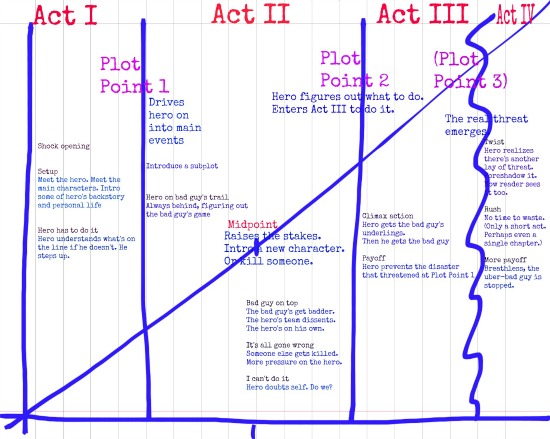
Another popular genre is the Thriller. Thrillers are novels of action, of constant forward momentum. Here's a diagram from Thriller writer Matt Rees showing basic plot points for a Thriller novel: Plot A Thriller.

THE SCARLET CRANE takes a very, very interesting fantastical premise and tries to map it onto a Thriller framework. It doesn't quite succeed. I felt the (fairly standard) thriller elements overshadowed the (underdeveloped) fantasy element.

That fantasy element is a doozy, though. In the world of THE SCARLET CRANE, the beginning of puberty also brings a one-month long period known as Transition. During that month, your eyes turn lavender. And... IF you perform the appropriate ceremony/invocation/prayer properly... and IF your invocation/prayer/wish has "uniqueness", if it's something that has never quite been wished for in quite the same way before by anyone else... then your prayer, your wish, might be granted. You can perform magic. You can perform miracles, from something small and inconsequential to literally rewriting the past.

BUT... here's the catch... if that invocation ISN'T properly performed... if that wish DOESN'T have that ill-defined quality of "uniqueness"... then you die. Stone cold freakin' dead, instantly. And that death, almost invariably, is what results from trying to invoke Transition magic. Successful Invocations are rarities.

What are the consequences of such a world? Hopkins shows us some. Knowledge of the Invocation ceremony is kept widely suppressed, especially from young people. (But it's also findable, with some effort, on the Internet or from other sources.) Parents go to extremes to prevent children from attempting Transition magic during that lavender-eyed month, including constant surveillance or even sedating their children during those weeks. There are government agencies devoted to dealing with Transition issues.

That's okay, so far as it goes. But I couldn't help feeling there should have been much bigger consequences to the existence of Transition magic. If Transition has existed for centuries or millenia, it would have had major, major, effects on history and society. How was the proper form of the Invocation originally discovered? How differently would religion have developed in a world where everyone has the potential to be a miracle-worker, but if your first attempt isn't pitch-perfect a fickle murderous God will strike you dead? Wouldn't there be entire libraries filled with the writings of theologians, philosophers, alchemists, scientists, all trying to understand the reason for Transition's existence and how it works? Or, conversely, wouldn't those few who invoked magic successfully and tried to pass on their experience be decried as witches and warlocks (which, essentially, they'd be) and burned or drowned to protect future generations? What of the adult miracle-workers throughout history (Oh, hi, Jesus!); what's up with those guys?

But the action of THE SCARLET CRANE takes place in a world almost brick-by-brick identical to our own. There's very little deep background or history to show Transition's long-term effects on society or history. Looking at the book as fantasy or science fiction, I found that disappointing. There are some hints that further books in the series (there are several) might go a little deeper into Transition's history, or show the wider effects of successful Transition magic.

Viewed a a Thriller novel, it's mostly successful. John Benoit and Stony Hill are US agents for an agency missioned with not only trying to protect kids from trying to use mostly-fatal Transition magic, but preventing kids from being manipulated by malign adults or government into Invoking magic hostile to US (or world) interests. The action moves right along, bam, bam, bam, leading to a final battle at a secret Chinese base where experiments with kidnapped children are making progress in controlling and weaponizing Transition magic. (Kids still die, but fewer of them, and Transition magic is successfully invoked more often.)

But... the relentless action, the constant forward momentum of the plot, also seemed to leave little room for much character development. John Benoit's distinguishing characteristics are carrying a cane (mostly for show, and for the concealed stiletto inside it), and that he's still an active agent at age 70. (I haven't seen a senior citizen action hero this spry since Manning Coles' Tommy Hambledon was still shinnying up drainpipes in his 80's.) I would have liked some understanding or background of what continues to motivate Benoit to do dangerous field work at an age when most agents would be driving a desk or have retired.

So, overall, pretty successful as a Thriller, with some reservations. As SF or Fantasy, some bigger reservations. The predominant Thriller plot and pacing makes Transition magic a MacGuffin for much of the book. ("MacGuffin" -- the object around which the plot revolves, but as to what that object specifically is the audience doesn't care -- attributed to Alfred Hitchcock.) Benoit and Hill's race toward the final chapter might have as easily involved a stolen nuclear bomb or plans for the Death Star, rather than the kidnapped children and secret base; Transition magic isn't an essential element of their quest.

But like I said, that whole concept of Transition is a doozy of an idea, with some great potential. I hope Hopkins develops that potential in further books. I'll almost certainly read the second book in the series, THE SAFFRON FALCON.